Junctional tachycardia
A junctional rhythm running faster than 100. Narrow and regular, with the P wave absent, inverted just in front of the QRS, or retrograde just after it. The rate over 100 separates it from accelerated junctional (60-100). The inverted P separates it from sinus tach, and from SVT, which usually runs faster with its P waves buried.
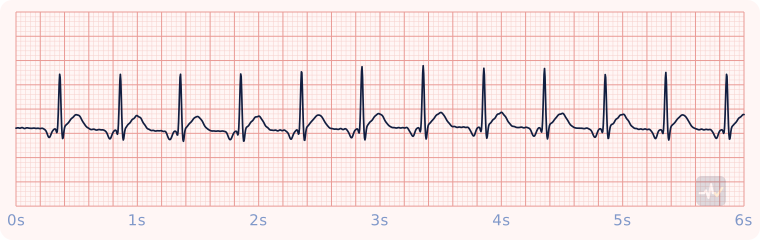
How to identify Junctional tachycardia
- Rate
- Over 100
- Rhythm
- Regular
- P waves
- Inverted just before the QRS, retrograde just after it, or absent
- PR interval
- Short when the inverted P comes first, otherwise none
- QRS
- Under 0.12 s
- Clincher
- Narrow and regular over 100 with an inverted or missing P. Over 100 separates it from accelerated junctional (60-100). A visible inverted P separates it from SVT, where the P is buried; with no P at all the two can look the same and are treated the same way at first.
- Common causes
- Think of digoxin toxicity and ischemia.
Rhythms it gets mistaken for
Junctional tachycardia vs Supraventricular tachycardia
Junctional tachycardia has an inverted P wave just before or just after each QRS. With SVT you would see no P wave you can see at all. It starts in the AV junction: a junctional rhythm.
Junctional tachycardia vs Accelerated junctional rhythm
Junctional tachycardia has a rate over 100/min. With accelerated junctional rhythm you would see a rate of 60-100/min.
Junctional tachycardia vs Sinus tachycardia
Junctional tachycardia has an inverted P wave just before or just after each QRS. With sinus tachycardia you would see one upright P wave before every QRS, all the same shape. It starts in the AV junction: a junctional rhythm.
Treatment by certification level
Open your level. Treat the patient, not the strip.
Paramedic
Stable
Stable junctional tachycardia: a regular narrow tachycardia, and a cause to find.
- Oxygen as needed, IV access, monitoring, 12-lead.
- Vagal maneuver, then adenosine 6 mg rapid IV push with a flush, then 12 mg if needed, as for SVT.
- A junctional focus firing on its own often does not convert with adenosine. Still fast: rate control with diltiazem or a beta blocker per protocol, with expert consultation.
- Look for the cause: digoxin toxicity and ischemia are the ones to think of.
Check the P waves before you call it SVT: an inverted P just before or just after each QRS points to the junction.
Unstable
Unstable junctional tachycardia: synchronized cardioversion.
- Sedate the conscious patient if time and blood pressure allow.
- Synchronized cardioversion starting at 50-100 J, as for any regular narrow tachycardia; escalate if it fails.
- A junctional focus firing on its own often does not convert. If shocks fail, get expert consultation and treat the cause rather than repeating them.
Unstable means hypotension, altered mental status, signs of shock, ischemic chest pain, or acute heart failure caused by the rate.
AEMT
Stable
Pulse present and stable.
- Oxygen only if hypoxic or short of breath, IV access, monitoring.
- Acquire and transmit a 12-lead ECG. Interpreting it is a Paramedic skill.
- Transport and reassess. Request a paramedic if the patient worsens.
Unstable
Unstable with a pulse.
- Oxygen if hypoxic, IV access, close monitoring.
- Expedited transport, with a paramedic intercept if that is genuinely faster than reaching the hospital.
Synchronized cardioversion and pacing are Paramedic-only, so the AEMT has no electrical option for a patient with a pulse. Never put the AED on this patient.
EMT
Stable
Pulse present: assess and support.
- Treat the patient, not the rhythm name: airway, breathing, circulation, vital signs.
- Oxygen if the SpO2 is under 94%, the patient is short of breath, or shows signs of shock.
- Request ALS and transport promptly. Reassess on the way.
An AED goes only on a patient who is unresponsive, not breathing and pulseless. It cannot feel a pulse, so on a patient with a pulse it can advise a shock that would do harm.
Unstable
Pulse present but poorly perfusing: this patient needs ALS fast.
- Treat the patient, not the rhythm name: airway, breathing, circulation, vital signs.
- Oxygen if the SpO2 is under 94%, the patient is short of breath, or shows signs of shock.
- Request ALS and transport promptly. Reassess on the way.
An AED goes only on a patient who is unresponsive, not breathing and pulseless. It cannot feel a pulse, so on a patient with a pulse it can advise a shock that would do harm.