Premature atrial complexes (PACs)
Also called premature atrial contractions, PACs.
An otherwise sinus rhythm with beats that arrive early. Each early beat has a P wave that looks different from the sinus P (it can hide in the T wave before it) and a narrow QRS.
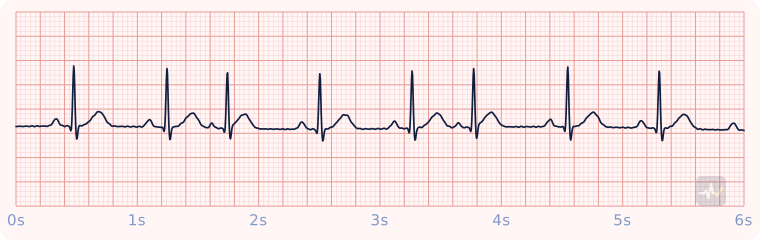
How to identify Premature atrial complexes (PACs)
- Rate
- That of the underlying sinus rhythm
- Rhythm
- Regular, interrupted by early beats
- P waves
- The early beat has a P that looks different, and it can hide in the T wave before it
- PR interval
- Normal, can be a little shorter on the early beat
- QRS
- Under 0.12 s
- Clincher
- An early, abnormally shaped P wave.
Rhythms it gets mistaken for
Premature atrial complexes (PACs) vs Unifocal PVCs
Premature atrial complexes (PACs) has an early P wave that looks different from the others. With unifocal PVCs you would see a P wave before each normal beat and no P wave in front of the early beats. A narrow QRS means the signal came from above the ventricles. The early beats start in the atria, not the SA node.
Premature atrial complexes (PACs) vs Sinus arrhythmia
Premature atrial complexes (PACs) has an early P wave that looks different from the others. With sinus arrhythmia you would see one upright P wave before every QRS, all the same shape. The early beats start in the atria, not the SA node.
Premature atrial complexes (PACs) vs Atrial fibrillation
Premature atrial complexes (PACs) has an early P wave that looks different from the others. With A-fib you would see no P waves, only a wavy, chaotic baseline.
Treatment by certification level
Open your level. Treat the patient, not the strip.
Paramedic
No rhythm treatment needed.
- Treat the patient in front of you, not the strip.
AEMT
Pulse present and stable.
- Oxygen only if hypoxic or short of breath, IV access, monitoring.
- Acquire and transmit a 12-lead ECG. Interpreting it is a Paramedic skill.
- Transport and reassess. Request a paramedic if the patient worsens.
EMT
Pulse present: assess and support.
- Treat the patient, not the rhythm name: airway, breathing, circulation, vital signs.
- Oxygen if the SpO2 is under 94%, the patient is short of breath, or shows signs of shock.
- Request ALS and transport promptly. Reassess on the way.
An AED goes only on a patient who is unresponsive, not breathing and pulseless. It cannot feel a pulse, so on a patient with a pulse it can advise a shock that would do harm.