Asystole
Also called flatline.
A flat line with only slow baseline drift. Confirm it in a second lead and check leads, cables and gain before calling it. Not shockable: CPR and epinephrine.
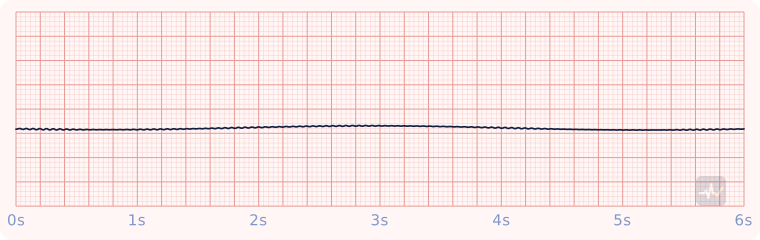
How to identify Asystole
- Rate
- None
- Rhythm
- None
- P waves
- None
- PR interval
- None
- QRS
- None
- Clincher
- A flat line. Confirm it in a second lead and check leads, cables and gain.
Rhythms it gets mistaken for
Asystole vs Ventricular fibrillation (fine)
Asystole has a flat line. With fine V-fib you would see only chaotic waves, with no P, QRS or T.
Asystole vs Idioventricular rhythm
Asystole has a flat line. With an idioventricular rhythm you would see distinct QRS complexes you can pick out.
Asystole vs Ventricular fibrillation (coarse)
Asystole has a flat line. With coarse V-fib you would see only chaotic waves, with no P, QRS or T.
Treatment by certification level
Open your level. Treat the patient, not the strip.
Paramedic
Non-shockable arrest.
- High-quality CPR. Never shock asystole or PEA.
- Confirm asystole in a second lead first: fine V-fib or a loose lead can look flat.
- Epinephrine 1 mg IV/IO as early as feasible, then every 3-5 minutes.
- No antiarrhythmic: there is no rhythm for one to act on.
- Hunt for the cause: the H's and T's.
- Two-minute cycles with a rhythm check. If it turns shockable, switch to the shock path.
- Waveform capnography. An abrupt rise in EtCO2 is often the first sign of ROSC.
AEMT
Cardiac arrest: CPR, the AED, epinephrine.
- High-quality CPR and the AED, exactly as at the EMT level. After every analysis, shock or no shock, compressions resume immediately.
- IV or IO access.
- Epinephrine 1 mg IV/IO as early as feasible, then every 3-5 minutes.
- Supraglottic airway and waveform capnography. EtCO2 under 10 mmHg means fix the compressions; an abrupt sustained rise suggests ROSC, confirmed at the scheduled rhythm check.
Manual defibrillation and antiarrhythmics (amiodarone, lidocaine) are Paramedic level. The AEMT's electrical therapy is the AED.
EMT
Cardiac arrest: CPR and the AED.
- High-quality CPR, starting with compressions.
- AED on as soon as it arrives.
- The AED will not advise a shock for this rhythm. Resume compressions immediately.
- Two minutes of CPR, then let the AED reanalyze. Check a pulse only at that scheduled rhythm check.