Idioventricular rhythm
The ventricle escaping on its own at 20-40. Very wide complexes, no P waves, very slow. It may be the only thing keeping the patient alive, so it is never suppressed with an antiarrhythmic.
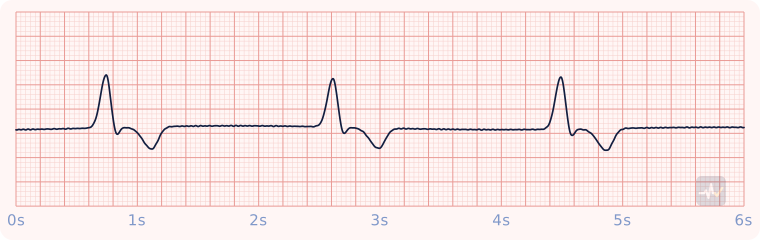
How to identify Idioventricular rhythm
- Rate
- 20-40
- Rhythm
- Regular
- P waves
- None
- PR interval
- None
- QRS
- Very wide
- Clincher
- Wide, slow, no P waves: the ventricle escaping on its own.
Rhythms it gets mistaken for
Idioventricular rhythm vs Accelerated idioventricular rhythm (AIVR)
Idioventricular rhythm has a rate of 20-40/min. With AIVR you would see a rate of 40-100/min.
Idioventricular rhythm vs Junctional escape rhythm
Idioventricular rhythm has a wide QRS, 0.12 s or more. With a junctional escape rhythm you would see a narrow QRS, under 0.12 s. A wide QRS means the signal started in the ventricles or got there through an abnormal path. It starts in the ventricles: a ventricular rhythm.
Idioventricular rhythm vs 3rd-degree (complete) AV block
Idioventricular rhythm has no upright P wave in front of the QRS. With 3rd-degree block you would see regular P waves, with more P waves than QRS complexes. It starts in the ventricles: a ventricular rhythm.
Treatment by certification level
Open your level. Treat the patient, not the strip.
Paramedic
Stable
An escape rhythm: protect it.
- Monitor, IV access, transport.
- Never suppress it with an antiarrhythmic.
Unstable
Symptomatic escape rhythm: speed it up, never suppress it.
- Atropine 1 mg can be tried, but a ventricular escape rarely responds. It never delays pacing.
- Transcutaneous pacing (rate 60-80, mA to capture, femoral pulse), or dopamine 5-20 mcg/kg/min, or epinephrine 2-10 mcg/min, titrated to effect.
- Never give an antiarrhythmic: this rhythm may be the only thing keeping the patient alive.
AEMT
Stable
Pulse present and stable.
- Oxygen only if hypoxic or short of breath, IV access, monitoring.
- Acquire and transmit a 12-lead ECG. Interpreting it is a Paramedic skill.
- Transport and reassess. Request a paramedic if the patient worsens.
Unstable
Symptomatic bradycardia with a pulse.
- Support oxygenation and ventilation, establish IV access, and move the patient.
- Expedited transport, with a paramedic intercept if that is genuinely faster than reaching the hospital.
Synchronized cardioversion and pacing are Paramedic-only, so the AEMT has no electrical option for a patient with a pulse. Never put the AED on this patient.
EMT
Stable
Pulse present: assess and support.
- Treat the patient, not the rhythm name: airway, breathing, circulation, vital signs.
- Oxygen if the SpO2 is under 94%, the patient is short of breath, or shows signs of shock.
- Request ALS and transport promptly. Reassess on the way.
An AED goes only on a patient who is unresponsive, not breathing and pulseless. It cannot feel a pulse, so on a patient with a pulse it can advise a shock that would do harm.
Unstable
Pulse present but poorly perfusing: this patient needs ALS fast.
- Treat the patient, not the rhythm name: airway, breathing, circulation, vital signs.
- Oxygen if the SpO2 is under 94%, the patient is short of breath, or shows signs of shock.
- Request ALS and transport promptly. Reassess on the way.
An AED goes only on a patient who is unresponsive, not breathing and pulseless. It cannot feel a pulse, so on a patient with a pulse it can advise a shock that would do harm.