PVC couplet
Two PVCs in a row. Three or more in a row is a run of ventricular tachycardia.
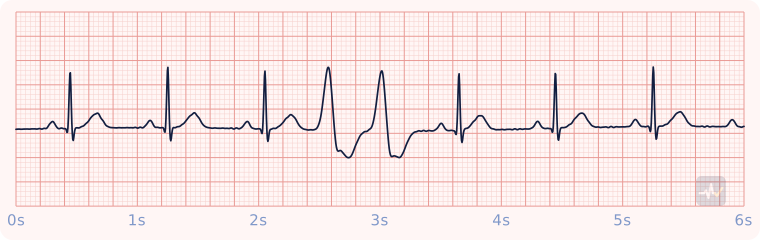
How to identify PVC couplet
- Rate
- That of the underlying rhythm
- Rhythm
- Regular, interrupted by a pair of early beats
- P waves
- None before the PVCs
- PR interval
- Normal on the sinus beats
- QRS
- The paired early beats are wide
- Clincher
- Two PVCs in a row. Three or more in a row is a run of V-tach.
Rhythms it gets mistaken for
PVC couplet vs Unifocal PVCs
PVC couplet has two early beats in a row. With unifocal PVCs you would see a regular rhythm interrupted by early beats.
PVC couplet vs Multifocal PVCs
PVC couplet has wide complexes that all look alike. With multifocal PVCs you would see wide early beats of more than one shape.
PVC couplet vs Ventricular tachycardia (monomorphic)
PVC couplet has a P wave before each normal beat and no P wave in front of the early beats. With V-tach you would see no upright P wave in front of the QRS.
Treatment by certification level
Open your level. Treat the patient, not the strip.
Paramedic
Treat the cause and monitor.
- No prophylactic antiarrhythmic for isolated ectopy, even in acute coronary syndrome. Treat the ischemia and watch the rhythm.
- Watch for the patterns that matter: R-on-T, couplets, multiformed, frequent uniform, bigeminy.
AEMT
Pulse present and stable.
- Oxygen only if hypoxic or short of breath, IV access, monitoring.
- Acquire and transmit a 12-lead ECG. Interpreting it is a Paramedic skill.
- Transport and reassess. Request a paramedic if the patient worsens.
EMT
Pulse present: assess and support.
- Treat the patient, not the rhythm name: airway, breathing, circulation, vital signs.
- Oxygen if the SpO2 is under 94%, the patient is short of breath, or shows signs of shock.
- Request ALS and transport promptly. Reassess on the way.
An AED goes only on a patient who is unresponsive, not breathing and pulseless. It cannot feel a pulse, so on a patient with a pulse it can advise a shock that would do harm.