Ventricular tachycardia (monomorphic)
Also called V-tach, VT.
Wide, bizarre QRS complexes (here about 0.20 s) at 150-250, regular, every complex the same shape, no identifiable P waves. A wide, fast, regular rhythm you cannot classify is V-tach until proven otherwise.
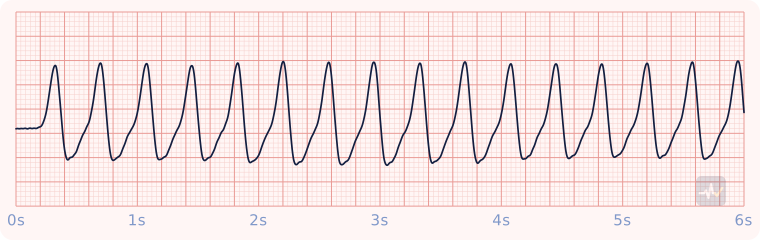
How to identify Ventricular tachycardia (monomorphic)
- Rate
- 150-250
- Rhythm
- Regular
- P waves
- None identifiable
- PR interval
- None
- QRS
- Wide and bizarre, every complex the same
- Clincher
- Wide, fast and regular. If you cannot classify it, assume V-tach.
Rhythms it gets mistaken for
Ventricular tachycardia (monomorphic) vs Supraventricular tachycardia
Ventricular tachycardia (monomorphic) has a wide QRS, 0.12 s or more. With SVT you would see a narrow QRS, under 0.12 s. A wide QRS means the signal started in the ventricles or got there through an abnormal path. It starts in the ventricles: a ventricular rhythm.
Ventricular tachycardia (monomorphic) vs Torsades de pointes
Ventricular tachycardia (monomorphic) has wide complexes that all look alike. With torsades you would see complexes that change height and direction, twisting around the baseline.
Ventricular tachycardia (monomorphic) vs Accelerated idioventricular rhythm (AIVR)
Ventricular tachycardia (monomorphic) has a rate of 150-250/min. With AIVR you would see a rate of 40-100/min.
Treatment by certification level
Open your level. Treat the patient, not the strip.
Paramedic
Stable
Stable V-tach: an antiarrhythmic, never a calcium channel blocker.
- Oxygen as needed, IV access, monitoring, and a 12-lead if it does not delay treatment.
- Adenosine 6 mg, then 12 mg, only if the rhythm is regular and monomorphic. Never for an irregular or polymorphic wide tachycardia.
- Amiodarone 150 mg IV infused over 10 minutes.
- Expert consultation: medical control.
- Never verapamil or diltiazem for a wide-complex tachycardia you cannot classify: it can cause collapse.
- Becomes unstable: synchronized cardioversion.
Stable blood pressure does not rule out V-tach. Age is not a differential either.
Unstable
Unstable V-tach with a pulse: synchronized cardioversion.
- Sedate the conscious patient if time and blood pressure allow.
- Synchronized cardioversion starting at 100 J. Confirm sync is marking each R wave; re-arm it after every shock.
- Not converting: escalate the energy on the next attempt.
- If the sync marker cannot track the QRS and the patient deteriorates, defibrillate instead.
No pulse
Pulseless V-tach: shockable arrest.
- CPR, pads on. Defibrillate (unsynchronized): biphasic 120-200 J (the maximum if you do not know the device recommendation), monophasic 360 J.
- Resume compressions immediately after the shock. No rhythm or pulse check first.
- IV/IO access. Epinephrine 1 mg every 3-5 minutes, typically after the second shock.
- Still shockable after a shock and epinephrine: amiodarone 300 mg IV/IO, then 150 mg if it persists. Lidocaine 1-1.5 mg/kg, then half that, is the alternative.
- Two-minute cycles: rhythm check, shock if shockable. Waveform capnography throughout.
- Look for and treat the cause: the H's and T's.
AEMT
Stable
Pulse present and stable.
- Oxygen only if hypoxic or short of breath, IV access, monitoring.
- Acquire and transmit a 12-lead ECG. Interpreting it is a Paramedic skill.
- Transport and reassess. Request a paramedic if the patient worsens.
Unstable
Unstable with a pulse.
- Oxygen if hypoxic, IV access, close monitoring.
- Expedited transport, with a paramedic intercept if that is genuinely faster than reaching the hospital.
Synchronized cardioversion and pacing are Paramedic-only, so the AEMT has no electrical option for a patient with a pulse. Never put the AED on this patient.
No pulse
Cardiac arrest: CPR, the AED, epinephrine.
- High-quality CPR and the AED, exactly as at the EMT level. After every analysis, shock or no shock, compressions resume immediately.
- IV or IO access.
- Epinephrine 1 mg IV/IO every 3-5 minutes, typically started after the second shock.
- Supraglottic airway and waveform capnography. EtCO2 under 10 mmHg means fix the compressions; an abrupt sustained rise suggests ROSC, confirmed at the scheduled rhythm check.
Manual defibrillation and antiarrhythmics (amiodarone, lidocaine) are Paramedic level. The AEMT's electrical therapy is the AED.
EMT
Stable
Pulse present: assess and support.
- Treat the patient, not the rhythm name: airway, breathing, circulation, vital signs.
- Oxygen if the SpO2 is under 94%, the patient is short of breath, or shows signs of shock.
- Request ALS and transport promptly. Reassess on the way.
An AED goes only on a patient who is unresponsive, not breathing and pulseless. It cannot feel a pulse, so on a patient with a pulse it can advise a shock that would do harm.
Unstable
Pulse present but poorly perfusing: this patient needs ALS fast.
- Treat the patient, not the rhythm name: airway, breathing, circulation, vital signs.
- Oxygen if the SpO2 is under 94%, the patient is short of breath, or shows signs of shock.
- Request ALS and transport promptly. Reassess on the way.
An AED goes only on a patient who is unresponsive, not breathing and pulseless. It cannot feel a pulse, so on a patient with a pulse it can advise a shock that would do harm.
No pulse
Cardiac arrest: CPR and the AED.
- High-quality CPR, starting with compressions.
- AED on as soon as it arrives.
- The AED will advise a shock for this rhythm. Clear, shock, then resume compressions immediately without a pulse check.
- Two minutes of CPR, then let the AED reanalyze. Check a pulse only at that scheduled rhythm check.