Upper Airway vs Lower Airway Sounds
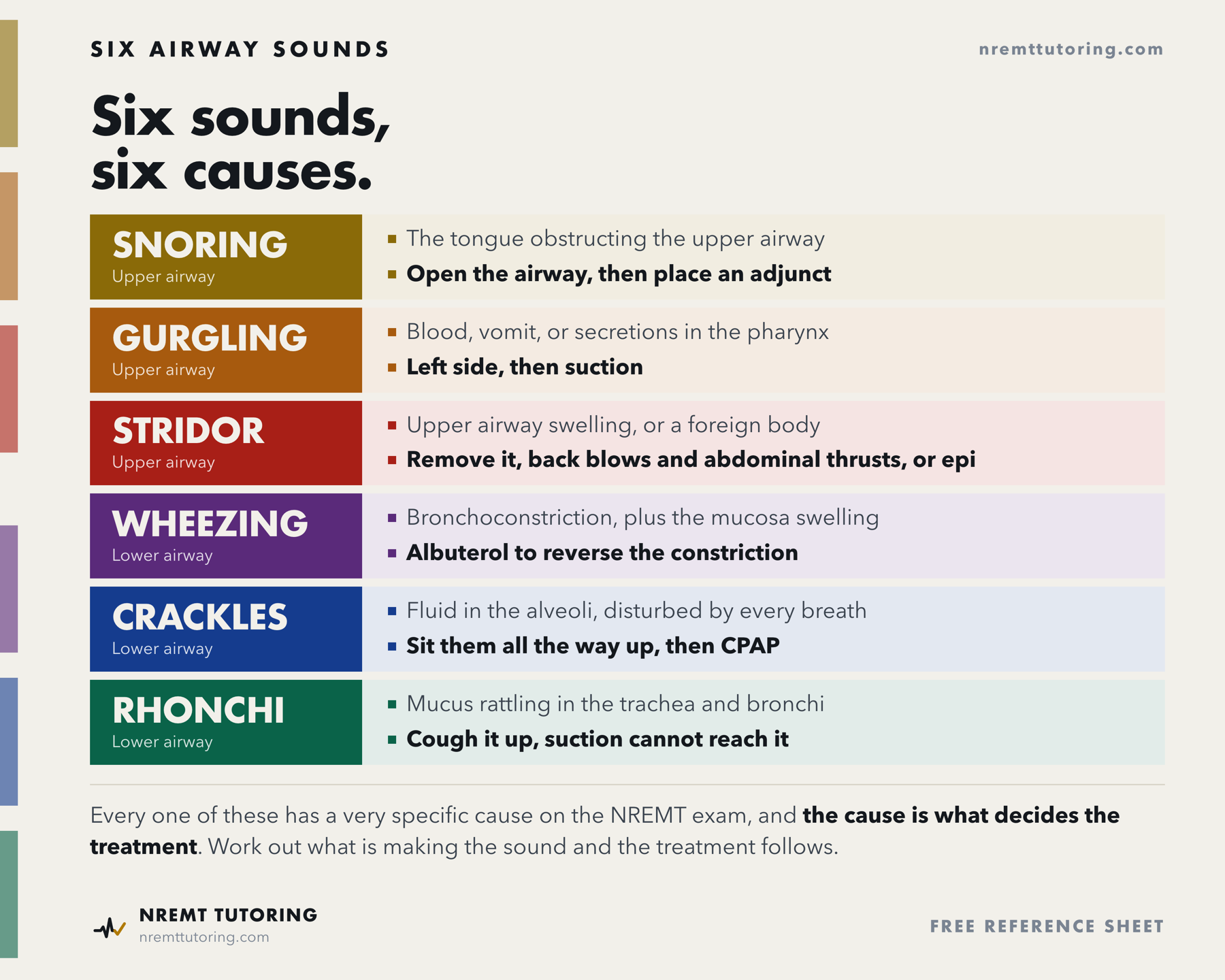
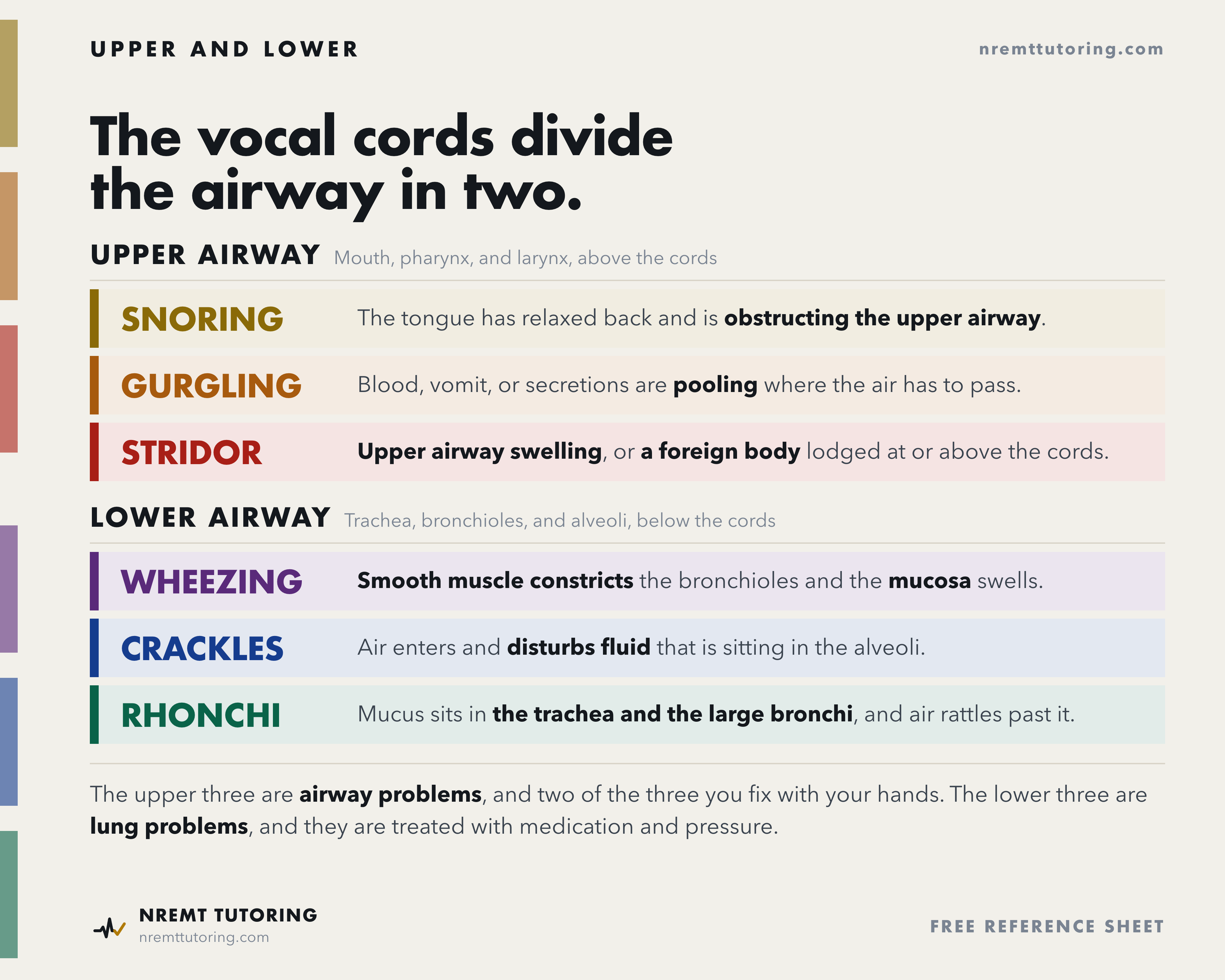
A free reference chart that splits the six airway sounds at the vocal cords. Snoring, gurgling, and stridor are made above them and are airway problems. Wheezing, crackles, and rhonchi are made below them and are lung problems, and the two groups are treated in completely different ways.
Free to save, print, and share with your class. Updated September 12, 2026.
The vocal cords are the dividing line
Everything above the vocal cords is the upper airway: the mouth, the pharynx, and the larynx. Everything below them is the lower airway: the trachea, the bronchioles, and the alveoli. Three of the six sounds are made on each side of that line.
Learn the line as anatomy rather than as a grouping to memorize, because it is also the line between two different kinds of problem and two different kinds of fix.
The upper three are airway problems
Snoring, gurgling, and stridor all mean something is in the way of air reaching the lungs. The lungs themselves can be perfectly healthy while the patient is making all three of those noises.
Two of the three you fix with your hands and a piece of plastic. Snoring is the tongue, so open the airway and place an oropharyngeal or nasopharyngeal airway. Gurgling is liquid pooling in the pharynx, so turn the patient onto their left side and suction. Stridor is the exception: you are either getting an object out or bringing swelling down, which means removing what you can see, back blows and abdominal thrusts if you cannot see it, or epinephrine for anaphylaxis.
The lower three are lung problems
Wheezing, crackles, and rhonchi are made past the point your hands or a catheter can reach. The airway is open. The problem is inside the lungs.
These are treated with medication and with pressure. Albuterol reverses the bronchoconstriction behind a wheeze. Sitting the patient all the way up and applying CPAP drives fluid back out of the alveoli behind crackles. Mucus in the trachea and the large bronchi has to be coughed up, because a suction catheter only reaches the mouth and the pharynx.
Placing the sound is the first decision
A question describes a patient making a noise, and the first useful move is to put the noise above or below the cords. Above, you are looking at something mechanical that you perform. Below, you are looking at a drug or at pressure.
That one decision removes half the answer choices before you have even named the sound. It is also why a stridor patient and a wheezing patient can read almost the same on paper and have nothing in common in the back of the ambulance.
Common questions
- What is the difference between upper and lower airway sounds?
- Where they are made. Upper airway sounds come from above the vocal cords, in the mouth, pharynx, and larynx, and they mean something is blocking air on its way to the lungs. Lower airway sounds come from below the cords, in the trachea, bronchioles, and alveoli, and they mean the problem is inside the lungs themselves.
- Which lung sounds come from the upper airway?
- Snoring, gurgling, and stridor. Snoring is the tongue obstructing the upper airway. Gurgling is blood, vomit, or secretions pooling in the pharynx. Stridor is swelling or a foreign body at or above the vocal cords.
- Which lung sounds come from the lower airway?
- Wheezing, crackles, and rhonchi. Wheezing is bronchoconstriction with the mucosa swelling. Crackles are fluid sitting in the alveoli. Rhonchi is mucus in the trachea and the large bronchi.
- Is stridor an upper or lower airway sound?
- Upper. Stridor is made at or above the vocal cords, which is why it is the one upper airway sound that a position and a suction catheter will not fix. You are either removing an object or bringing swelling down.
- Why does it matter where the sound is made?
- Because it decides the kind of treatment. Upper airway sounds are fixed mechanically: a position, an airway adjunct, suction, back blows and abdominal thrusts. Lower airway sounds are fixed with medication and pressure: albuterol, CPAP, and treating what is producing the mucus. Placing the sound above or below the cords rules out half the answer choices immediately.
- Can I print this airway sounds chart or use it in class?
- Yes. The chart is free to view, download, print, and share with your class or study group. A link back to nremttutoring.com is appreciated but not required.
Now go answer questions on it
A chart tells you what separates them. Questions are what prove you can do it under time. Practice is free and unlimited, with a full explanation on every answer.
Start free practice