The Six Airway and Lung Sounds
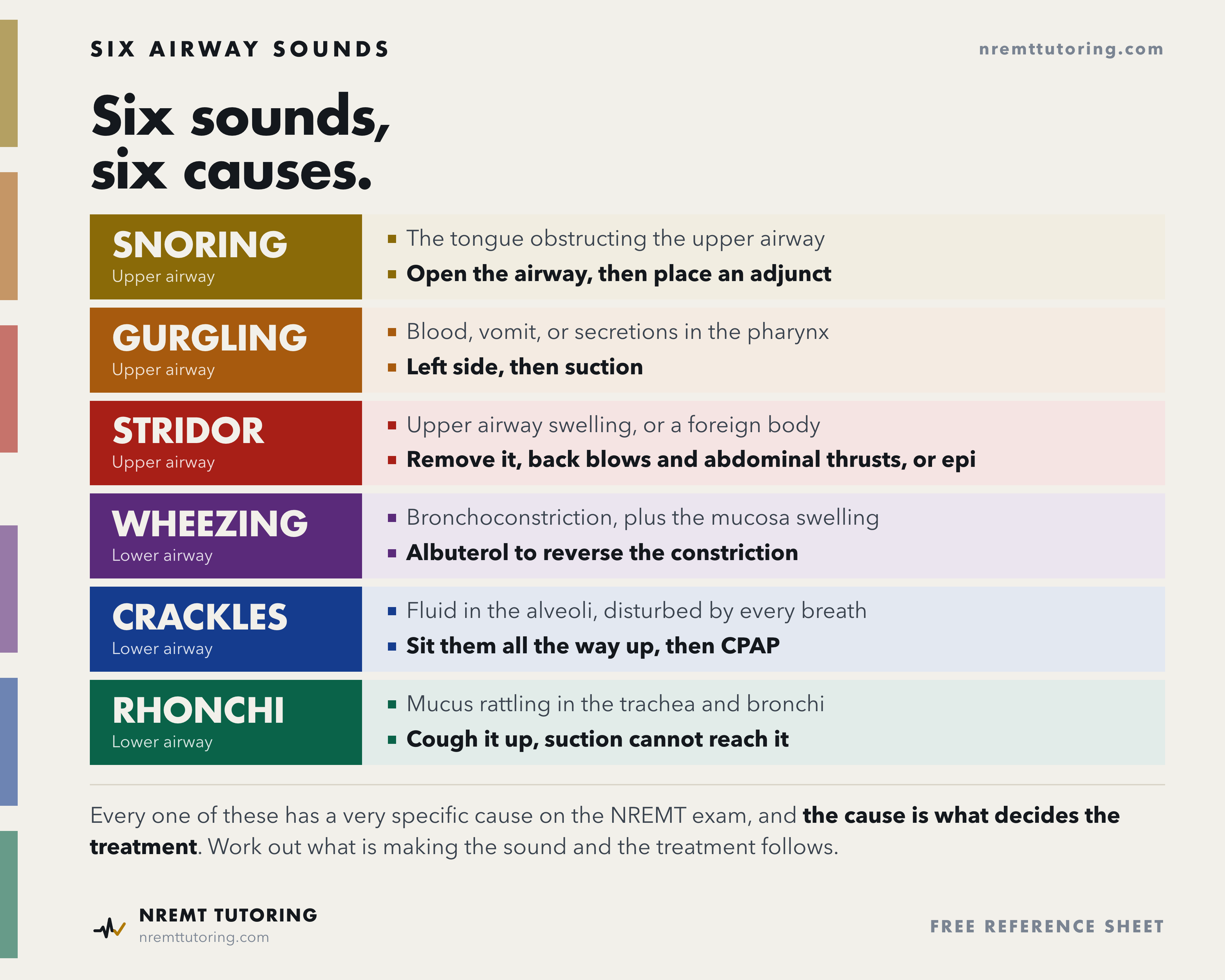
A free reference chart with all six sounds on one page: snoring, gurgling, stridor, wheezing, crackles, and rhonchi. Each one gets the cause that makes it and the treatment that follows, because on the National Registry the cause is what decides the treatment.
Free to save, print, and share with your class. Updated September 13, 2026.
The sound is not the answer, the cause is
A question will rarely name the sound it is testing and then ask you what it is. It describes a patient, and the sound is one finding among several. What earns the point is knowing what is physically making that noise, because the treatment follows from the cause and from nothing else.
Two patients can both be noisy and need opposite things. A snoring patient needs your hands. A wheezing patient needs a medication. A patient with crackles needs to sit all the way up and get pressure. Work out what is making the sound and the treatment stops being a list to memorize.
The three sounds made above the vocal cords
Snoring is the tongue. An unresponsive patient loses the muscle tone that holds it forward, so it falls back against the pharynx and air squeezes past. Open the airway with a head tilt chin lift, or a jaw thrust if you are holding spinal precautions, then place an oropharyngeal or nasopharyngeal airway to maintain patency.
Gurgling is liquid. Blood, vomit, or secretions are sitting in the pharynx exactly where the air has to pass. Roll the patient onto their left side so gravity carries it out of the mouth rather than down, then suction. Suction for 15 seconds in an adult, 10 in a child, and 5 in an infant.
Stridor is a narrowed upper airway, either swelling or a foreign body lodged at or above the cords. Remove the object if you can see it, back blows and abdominal thrusts if you cannot, and epinephrine if it is swelling from anaphylaxis.
The three sounds made below them
Wheezing is bronchoconstriction. Smooth muscle tightens around the bronchioles and the mucosa, their lining, swells at the same time, so two things are narrowing the same tubes. Albuterol reverses the constriction.
Crackles are fluid in the alveoli. Air comes in, meets fluid that does not belong there, and pops it apart with every breath. Pulmonary edema from left heart failure is the common cause. Drowning puts water in the same place. Blunt force trauma to the chest bleeds into the alveoli and gets there a third way. Sit the patient all the way up, then CPAP.
Rhonchi is mucus. It sits in the trachea and the large bronchi and air rattles past it, which is why it sounds low and coarse rather than fine, and why it often changes or clears when the patient coughs.
Placing the sound above or below the cords is the first decision
Everything above the vocal cords is the upper airway: the mouth, the pharynx, and the larynx. Everything below them is the lower airway: the trachea, the bronchioles, and the alveoli. Three of the six sounds are made on each side of that line, and the line separates two different kinds of problem and two different kinds of fix. Above it, something is in the way of air reaching the lungs, and the lungs themselves can be perfectly healthy. Below it, the airway is open and the problem is inside the lungs, past the point your hands or a catheter can reach.
A question describes a patient making a noise, and the first useful move is to put the noise above or below the cords. Above, you are looking at something mechanical that you perform: a position, an adjunct, suction, back blows and abdominal thrusts. Below, you are looking at a drug or at pressure. That one decision removes half the answer choices before you have even named the sound, which is why a stridor patient and a wheezing patient can read almost the same on paper and have nothing in common in the back of the ambulance.
Crackles and rhonchi are the pair that gets swapped
Sputum and secretions make rhonchi. Fluid in the alveoli makes crackles. The two never trade places, and a patient with a productive cough and a coarse rattle is not in pulmonary edema no matter how wet the chest sounds.
The history usually settles it before the sound does. A cardiac history with a fine, wet sound at the bases is crackles. A fever, a productive cough, and a coarse rattle that shifts when they cough is rhonchi. Rhonchi over one lower lobe is often how a pneumonia announces the lobe it started in, and a pneumonia can produce both sounds, so read what the question actually describes rather than keying off the diagnosis.
You cannot suction rhonchi out
A suction catheter reaches the mouth and the pharynx. That is its entire range. Mucus sitting in the trachea and the large bronchi is below anything you can reach, so suctioning a patient with rhonchi accomplishes nothing except taking them off oxygen while you do it.
That mucus comes up by coughing. Suction is the answer for gurgling, which is fluid you can see and reach, and it is the wrong answer for rhonchi every time.
Where the word rales fits
Rales is an older term that is still in everyday use. Most people who say it mean crackles. Plenty of others use it for rhonchi too, and some use it for anything wet they hear in a chest.
The National Registry uses it interchangeably with both of them, so the word on its own tells you nothing. It does not say whether there is fluid in the alveoli or mucus in the large airways, and those two do not get treated the same way. The patient history and the clinical findings are what tell you whether rales is referring to crackles or to rhonchi.
Common questions
- What are the six airway and lung sounds?
- Snoring, gurgling, and stridor are made above the vocal cords, in the upper airway. Wheezing, crackles, and rhonchi are made below them, in the lower airway. Each one has a specific cause, and that cause is what decides the treatment.
- What is the difference between upper and lower airway sounds?
- Where they are made. Upper airway sounds come from above the vocal cords, in the mouth, pharynx, and larynx, and they mean something is blocking air on its way to the lungs, so they are fixed mechanically: a position, an airway adjunct, suction, back blows and abdominal thrusts. Lower airway sounds come from below the cords, in the trachea, bronchioles, and alveoli, and they mean the problem is inside the lungs themselves, so they are treated with medication and pressure.
- What causes crackles?
- Fluid sitting in the alveoli, which air disturbs on the way in. Pulmonary edema from left heart failure is the common cause. Drowning puts water in the alveoli directly, and blunt force trauma to the chest bleeds into them. All three put fluid where air belongs. Sit the patient all the way up, then apply CPAP.
- What causes rhonchi?
- Mucus and secretions sitting in the trachea and the large bronchi, with air rattling past them. Bronchitis, pneumonia, COPD with a productive cough, and aspiration all produce it. It sounds low and coarse rather than fine, and it often changes or clears when the patient coughs.
- What is the difference between crackles and rhonchi?
- The substance and the depth. Crackles are fluid down in the alveoli, so the sound is fine and wet and it does not clear with a cough. Rhonchi is mucus up in the trachea and the large bronchi, so the sound is low and coarse and coughing often changes it. The two never trade places.
- Can you suction rhonchi?
- No. A suction catheter reaches the mouth and the pharynx and nothing deeper, and the mucus making rhonchi is sitting in the trachea and the large bronchi, well below that. It has to be coughed up. Suction is the treatment for gurgling, not for rhonchi.
- What is the treatment for stridor?
- It depends on what is narrowing the airway. Remove the object if you can see it. Back blows and abdominal thrusts if you cannot. Epinephrine if the narrowing is swelling from anaphylaxis. Stridor is the one upper airway sound that a position and a suction catheter will not fix.
- Is stridor an upper or lower airway sound?
- Upper. Stridor is made at or above the vocal cords, which is why it is the one upper airway sound that a position and a suction catheter will not fix. You are either removing an object or bringing swelling down.
- What does rales mean?
- Rales is an older word that most people use for crackles, though plenty of people use it for rhonchi as well. The National Registry uses it interchangeably with both, so the word by itself does not tell you whether there is fluid in the alveoli or mucus in the large airways. Use the patient history and the clinical findings to decide which one is being described.
- Can I print this lung sounds chart or use it in class?
- Yes. The chart is free to view, download, print, and share with your class or study group. A link back to nremttutoring.com is appreciated but not required.
Now go answer questions on it
A chart tells you what separates them. Questions are what prove you can do it under time. Practice is free and unlimited, with a full explanation on every answer.
Start free practice