The Four Types of Shock
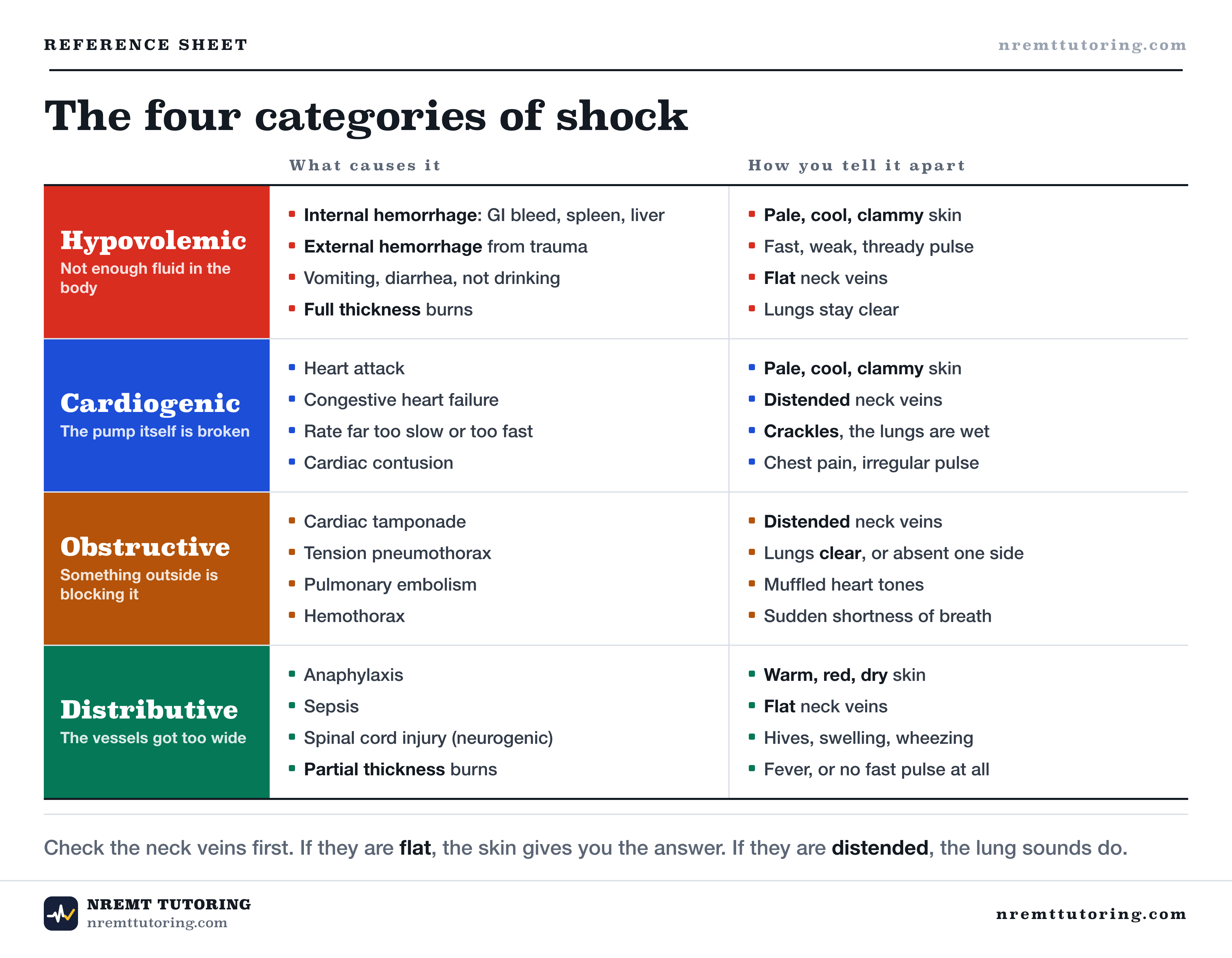
A free reference chart that puts hypovolemic, cardiogenic, obstructive, and distributive shock side by side: what causes each one, and the findings that actually separate them on a real patient. Print it, save it, or work through it below.
Free to save, print, and share with your class. Updated September 9, 2026.
How to read the chart
The left column names the category and states its mechanism in one sentence. The middle column lists the diseases and trauma scenarios that produce it, because a question describes a patient rather than naming the category outright. The right column is the part most charts leave out: the handful of findings that separate this category from the other three.
Shock is not low blood pressure. Shock is not enough oxygen reaching the cells. Blood pressure is one way to notice that the delivery has failed, and it is one of the last things to change. Before you name a category, ask the question the whole chart is built around: why is the oxygen not getting there?
Start with the neck veins
Two findings will name the category, which is faster and steadier than recalling signs for all four with a patient in front of you.
Flat neck veins mean the system is underfilled, so the answer is hypovolemic or distributive. The skin splits that pair. Pale, cool, clammy skin is hypovolemic, because the vessels have clamped down to protect what fluid is left. Warm, red, dry skin is distributive, because the vessels opened up.
Distended neck veins mean blood is backing up because it cannot get through the chest, so the answer is cardiogenic or obstructive. The lung sounds split that pair. Crackles mean the pump failed and fluid backed up into the lungs. Clear lungs mean the pump is fine and something outside it is in the way.
Two places a patient ends up in the wrong category
A bad heart rate is only cardiogenic if the heart caused it. A rate of 30 after three minutes without an airway is hypoxia. Tachycardia on day four of vomiting and diarrhea is compensation. Ask whether the heart rate is causing the shock, or trying to compensate for another problem.
Cardiac tamponade has "cardiac" in the name and it is not cardiogenic. The heart sits in a tough sac that does not stretch. Blood fills that sac, and with nowhere to go it presses in on the heart from every side, so the chambers cannot fill between beats. The muscle itself is healthy the whole time, which is exactly what makes it obstructive.
Burns split by depth, not by size
The deciding question with a burn is where the fluid went. A full thickness burn destroys every skin layer, so no barrier is left to hold fluid in. Plasma escapes the body and circulating volume actually falls, which is hypovolemic shock.
A partial thickness burn leaves the barrier intact and drives swelling and vessel dilation that pushes fluid out of the vessels into the surrounding tissue. Total body volume is unchanged, so that shock is distributive.
Compensated and decompensated are not a fifth category
Each of the four categories can be compensated or decompensated. That staging describes how well the body is still holding perfusion, not what went wrong, so it never replaces naming the category.
A compensated patient is pale, cool and clammy, anxious, restless and thirsty, with a weak radial pulse and slow capillary refill, and the blood pressure is still normal. A decompensated patient has a pulse that weakens and then slows, breathing that turns shallow and irregular, skin that turns cyanotic or mottled, and a blood pressure that has finally fallen. Everything in that second list is a late finding, which is why a normal blood pressure never rules shock out.
Common questions
- What are the four types of shock?
- Hypovolemic (not enough fluid in the body), cardiogenic (the pump itself is broken), obstructive (something outside the heart is blocking circulation), and distributive (the vessels got too wide, so fluid leaves them for the surrounding tissue). Each of the four can be compensated or decompensated, and that staging describes how well the body is still holding perfusion, so it is not a fifth category.
- What is the fastest way to tell the four types of shock apart?
- Check the neck veins first. Flat neck veins mean the system is underfilled, which narrows it to hypovolemic or distributive, and the skin splits that pair: pale, cool and clammy is hypovolemic, while warm, red and dry is distributive. Distended neck veins mean blood is backing up in the chest, which narrows it to cardiogenic or obstructive, and the lung sounds split that pair: crackles are cardiogenic, clear lungs are obstructive. Two findings name the category.
- How do you tell cardiogenic shock from obstructive shock?
- Cardiogenic shock comes from a problem inside the heart muscle or its electrical system, such as a heart attack, congestive heart failure, or a rate far too slow or too fast. Obstructive shock comes from something outside the heart compressing or blocking it, such as cardiac tamponade, tension pneumothorax, or a pulmonary embolism. In cardiogenic shock the lungs are wet and you hear crackles. In obstructive shock the pump is working and the lungs stay clear, or breath sounds are absent on one side.
- Do burns cause hypovolemic or distributive shock?
- It depends on the depth, and the test is whether fluid left the body or only left the vessels. A full thickness burn destroys every skin layer, so plasma escapes the body and circulating volume falls, which is hypovolemic shock. A partial thickness burn leaves the barrier intact and only pushes fluid out of the vessels into surrounding tissue, so total volume is unchanged and the shock is distributive.
- Can I print this shock chart or use it in class?
- Yes. The chart is free to view, download, print, and share with your class or study group. A link back to nremttutoring.com is appreciated but not required.
Go deeper
NREMT Shock Review: The Four Major Types of ShockNow go answer questions on it
A chart tells you what separates them. Questions are what prove you can do it under time. Practice is free and unlimited, with a full explanation on every answer.
Start free practice