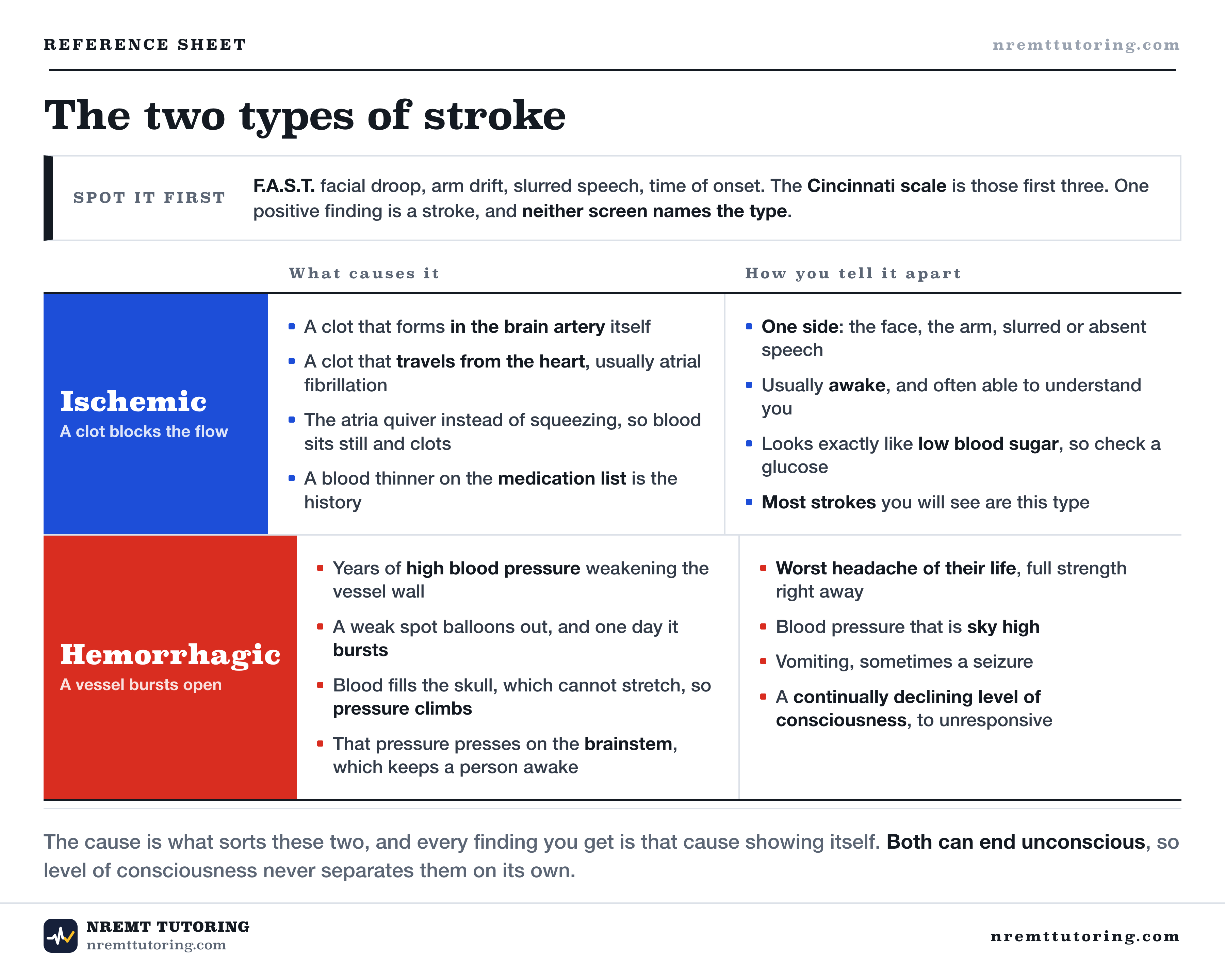
Ischemic vs Hemorrhagic Stroke
A free reference chart comparing the two types of stroke: where a clot comes from, what years of pressure do to a vessel wall, and the findings that separate a clot from a bleed. It also covers what F.A.S.T. and the Cincinnati scale actually tell you, which is that a stroke is happening and not which type.
Free to save, print, and share with your class. Updated September 9, 2026.
The screen tells you it is a stroke, not which type
F.A.S.T. is facial droop, arm drift, slurred speech, and time of onset or last known normal. The Cincinnati Prehospital Stroke Scale is the first three of those, and F.A.S.T. adds the clock. One positive finding is enough to treat the patient as a stroke.
Neither tool names the type, and neither one is built to. What sorts the two is the cause, and every finding you get is that cause showing itself.
Where the clot comes from
Some clots form right in the brain artery. Others start somewhere else in the body and travel there, and the most common place a travelling clot starts is the heart, in atrial fibrillation.
The atria quiver instead of squeezing, so blood sits still inside the heart and clots. That clot gets pumped out with the next good beat and travels until it reaches a vessel too small to pass through, which is often in the brain. The stroke started in the heart.
A question may never say atrial fibrillation. It hands you a medication list instead, and a blood thinner sitting on that list is telling you the history.
Why a bleed hits the whole brain
The vessel breaks open and blood pours out into the skull. The skull is solid bone, so it cannot stretch or make room, and that blood has nowhere to go.
It keeps collecting and it starts pressing on the brain itself. The pressure does not stay where the vessel broke. It builds against every part of the brain at once, including the brainstem, which is the part that keeps a person awake. That is why a bleed does not leave you with one weak side, and why these patients go from confused, to sleepy, to unresponsive.
Level of consciousness is a tendency and not a rule. Both types can end unresponsive, so consciousness alone never separates them.
Check a glucose on every altered patient
Awake, confused, slurred speech, weak on one side. That describes a stroke, and it also describes a blood sugar of 40.
The neurological findings will not separate them. The skin will. Low blood sugar sets off a stress response, so that patient turns cool, pale and clammy, while a stroke patient is usually warm and dry. The skin is the hint and the glucometer is the answer. One of them reverses with sugar in a few minutes, and the other needs a hospital and a clock.
Thunderclap headache, and the findings added to pull you off it
A thunderclap headache arrives at full strength right away, severe from the first minute instead of working up to it. On the National Registry that phrase has one job, which is to describe a hemorrhagic stroke. It is never put there to point you at a clot. Some patients say they heard or felt a pop inside their head at the moment the vessel gave out.
Neck stiffness is a classic meningitis finding, and it gets dropped into a hemorrhagic question on purpose. Blood around the brain irritates the same lining, so the finding is real. It is still not meningitis. Sensitivity to light is the same move. Read the whole question, because sudden onset with no fever is not an infection.
Common questions
- What is the difference between an ischemic and a hemorrhagic stroke?
- An ischemic stroke is a clot that plugs one artery, so only the area behind that artery loses its blood supply, and that area runs one side of the body. A hemorrhagic stroke is a vessel that bursts open, and the blood fills a skull that cannot make room, so pressure builds against the whole brain at once. The clot produces one sided findings in a patient who is usually awake. The bleed produces the worst headache of their life, a sky high blood pressure, and a continually declining level of consciousness.
- Does F.A.S.T. tell you which type of stroke it is?
- No. F.A.S.T. and the Cincinnati Prehospital Stroke Scale both tell you that you are looking at a stroke, and neither one names the type. F.A.S.T. is facial droop, arm drift, slurred speech, and time of onset. The Cincinnati scale is the first three of those. One positive finding is enough to treat the patient as a stroke.
- What is the most common cause of an ischemic stroke?
- A clot that travels from the heart, most often because of atrial fibrillation. The atria quiver instead of squeezing, so blood sits still inside the heart and clots. That clot gets pumped out with the next good beat and travels until it reaches a vessel too small to pass through, which is often in the brain. A question may hand you a medication list with a blood thinner on it rather than naming atrial fibrillation.
- Why does a stroke look like low blood sugar?
- Both produce an awake, confused patient with slurred speech and one sided weakness, and the neurological findings will not separate them. The skin does. Low blood sugar sets off a stress response that turns the patient cool, pale and clammy, while a stroke patient is usually warm and dry. Check a glucose on every altered patient before committing to stroke.
- Can I print this stroke chart or use it in class?
- Yes. The chart is free to view, download, print, and share with your class or study group. A link back to nremttutoring.com is appreciated but not required.
Now go answer questions on it
A chart tells you what separates them. Questions are what prove you can do it under time. Practice is free and unlimited, with a full explanation on every answer.
Start free practice