Patient Positioning
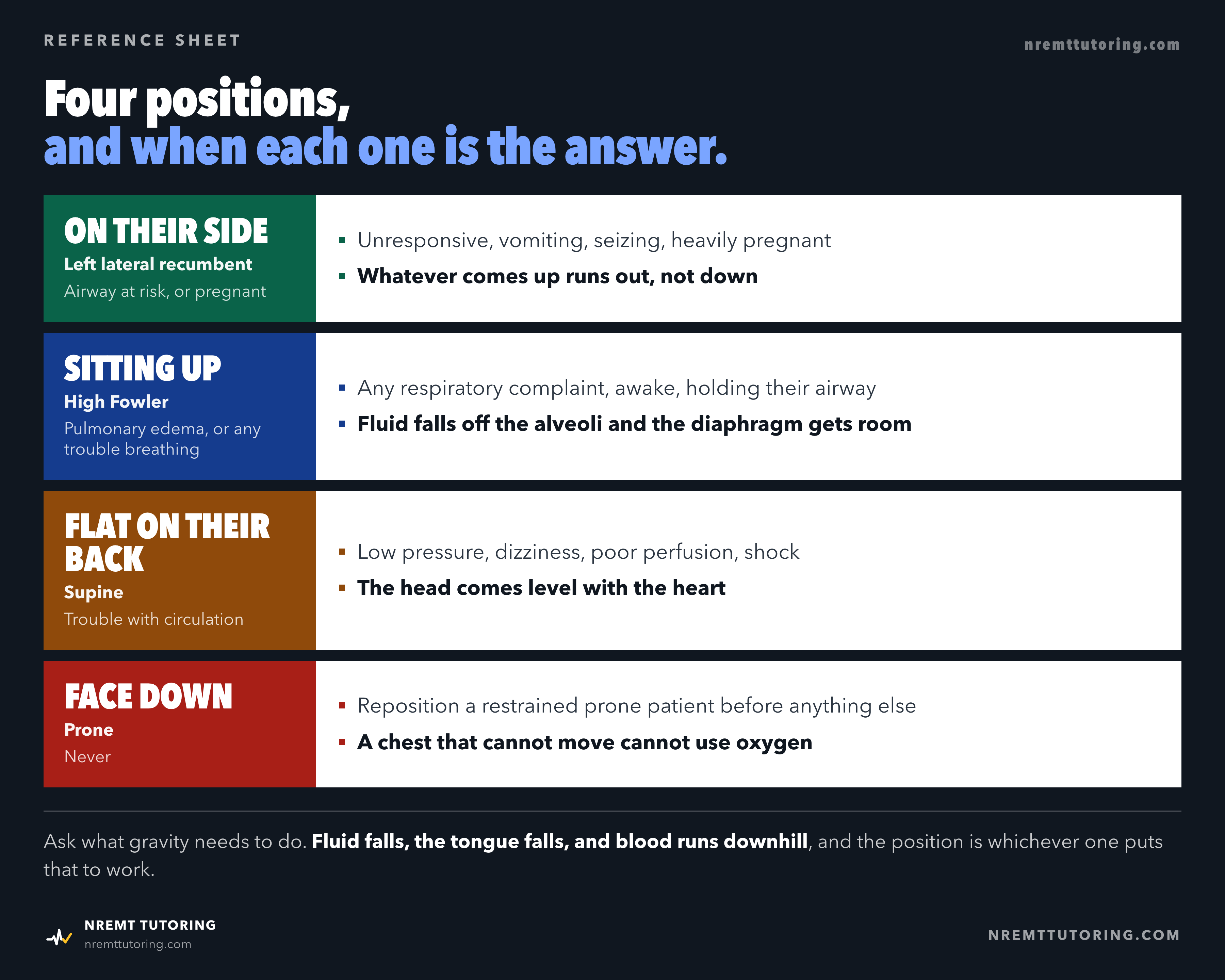
A free reference chart covering the four patient positions the National Registry asks about: left lateral recumbent, High Fowler, supine, and prone. It gives the technical name for each one, the patients who get it, and the reason it works, which is always what gravity is doing.
Free to save, print, and share with your class. Updated September 12, 2026.
Every positioning question is a gravity question
Positioning looks like a list to memorize, and it is not. Each position is doing one job, which is putting gravity to work on whatever is wrong with the patient. Fluid falls, the tongue falls, and blood runs downhill. Decide what you need gravity to do and the position picks itself.
That is also why the wrong answers are wrong. A position that sends the fluid the wrong way, or takes the chest out of the picture, is not a comfort problem. It is a mechanics problem.
Left lateral recumbent is two answers wearing one name
A patient who cannot protect their own airway goes on their side. Unresponsive, actively vomiting, seizing, or postictal and not fully awake. Gravity sends whatever comes up out of the mouth rather than down the trachea, and that is the whole reason.
A heavily pregnant patient goes on her left for a different reason entirely. The vena cava is the vein carrying blood back to the heart, and it runs up the right side of the spine. Lying flat, the weight of the uterus presses directly on it. Roll her onto her left and the uterus falls away from that vein, so blood reaches the heart again.
Two situations keep her flat instead. Compressions do not work on a patient lying on her side, and spinal precautions need her in line with the board. In both, the weight still has to come off the vein: someone pushes the uterus toward her left and holds it there, or the whole board is tilted onto its left edge.
High Fowler is pulmonary edema before anything else
High Fowler means sitting all the way upright, and the patient in pulmonary edema will already be doing it before you get there. Sitting up pulls the fluid down to the bases of the lungs. The alveoli above that fluid line are no longer covered, so they hold air again.
Sitting up does a second thing at the same time. The abdomen drops away from the diaphragm, so the chest has room to move instead of fighting the weight of everything below it. Every awake patient with a respiratory complaint who is holding their own airway benefits from the same two effects.
Supine is for circulation, flat and level
Low blood pressure, dizziness, poor perfusion, shock. Lay the patient flat so the head is level with the heart and the blood is not climbing uphill to get to the brain.
Flat and level is the answer. Raising the hips above the head is a separate maneuver used in a prolapsed cord, and it is not the same thing as tilting a whole patient head down.
Prone is never the answer
Prone means face down, and a patient lying prone cannot expand their chest. The weight of their own body sits on the diaphragm and the floor is in the way of the ribs, so the air has nowhere to go.
This matters most with a restrained patient. Face down, restrained, and held there is how a patient stops being able to breathe while everyone in the room is watching. Find a restrained patient face down and in respiratory distress and the first thing you do is reposition them, before oxygen. Oxygen does not fix a chest that cannot move.
Two positions that exist for one problem each
A child's head is large compared to the rest of them. Lay a child flat and the back of the head lands before the shoulders do, which pushes the chin toward the chest and closes the airway. Pad under the shoulders until the chin comes up and the ear sits level with the shoulder. That is the sniffing position, and it looks like the name says.
When the umbilical cord slips out ahead of the baby, the baby presses down on it and shuts off its own oxygen. Slide a gloved hand in, lift the head off the cord, and hold it there the whole way in. Never push the cord back. Put her knee to chest, or prop her hips above her head, so the baby's weight comes off the cord. An abnormal delivery is finished at the hospital, not on scene.
Common questions
- What position do you put an unresponsive patient in?
- On their side, in the left lateral recumbent position, as long as nothing rules it out. A patient who is unresponsive is not protecting their own airway, and on their side gravity sends anything that comes up out of the mouth instead of down into the trachea. The same applies to a patient who is actively vomiting, seizing, or postictal and not fully awake.
- Why do you put a pregnant patient on her left side?
- The vena cava is the vein carrying blood back to the heart, and it runs up the right side of the spine. Late in pregnancy, a patient lying flat has the full weight of the uterus pressing on that vein, so less blood gets back to the heart. Rolling her onto her left lets the uterus fall away from the vein. Left specifically, because the vein is on the right.
- What position does a pregnant patient go in for CPR or spinal precautions?
- Flat on her back, with the uterus displaced. Compressions do not work on a patient lying on her side, and spinal precautions need her in line with the board, so she cannot be turned. Someone pushes the uterus toward her left and holds it there, which is manual uterine displacement, or the whole backboard is tilted onto its left edge. Either way the weight comes off the vena cava.
- What is High Fowler position used for?
- Trouble breathing, and pulmonary edema most of all. High Fowler is sitting all the way upright. It pulls the fluid down to the bases of the lungs so the alveoli above it can hold air again, and it drops the abdomen away from the diaphragm so the chest has room to move.
- Why is prone never the correct answer on the NREMT?
- A patient lying face down cannot expand their chest. Their own body weight is on the diaphragm and the floor blocks the ribs, so the air has nowhere to go. A chest that cannot move cannot use oxygen no matter how much you give, which is why a restrained prone patient in respiratory distress gets repositioned before anything else.
- Can I print this patient positioning chart or use it in class?
- Yes. The chart is free to view, download, print, and share with your class or study group. A link back to nremttutoring.com is appreciated but not required.
Now go answer questions on it
A chart tells you what separates them. Questions are what prove you can do it under time. Practice is free and unlimited, with a full explanation on every answer.
Start free practice