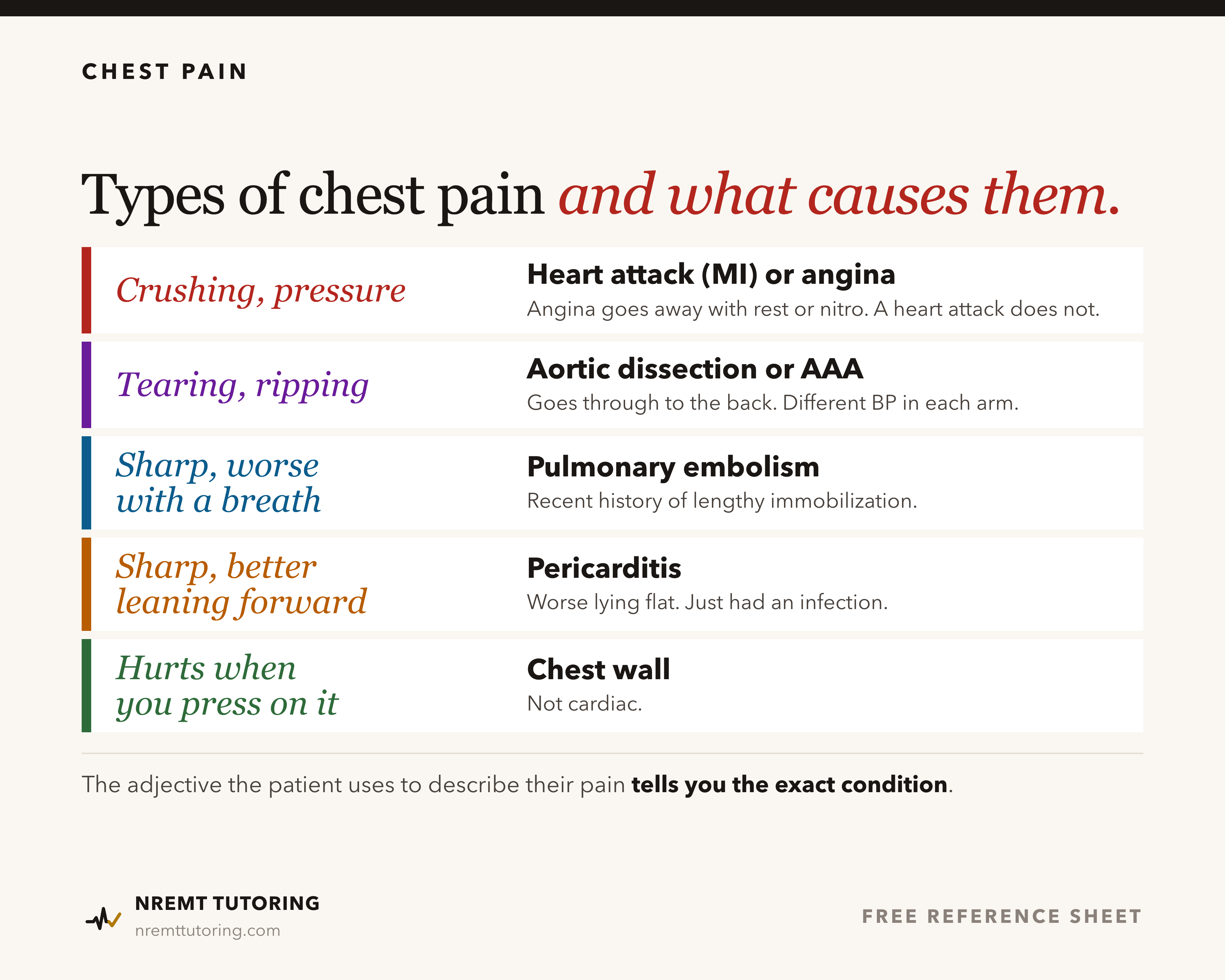
Types of Chest Pain and What Causes Them
A free reference chart that matches the five ways a patient describes chest pain to the condition behind each one: crushing pressure is a heart attack or angina, tearing is aortic dissection or AAA, sharp and worse with a breath is a pulmonary embolism, sharp and better leaning forward is pericarditis, and pain that hurts when you press on it is the chest wall.
Free to save, print, and share with your class. Updated October 10, 2026.
The adjective is the answer
A question about chest pain almost always tells you how the pain feels, and that one word does most of the work. Crushing or pressure points at the heart. Tearing points at the aorta. Sharp points away from the heart muscle and toward the lungs, the sac around the heart, or the chest wall.
Once the adjective puts you in the right row, the second column of the chart gives you the finding that confirms it: what happens with rest or nitro, whether it goes through to the back, a history of lying still for a long time, how it changes with position, or whether pressing on it brings it back.
First question: what brings the pain on?
Cardiac chest pain comes from the heart muscle not getting enough oxygen, either from a clot stopping blood flow or from blood vessels constricting. The clot is the heart attack. The vessel constriction is the angina. That is why rest or nitro will fix angina, but it will not remove the clot from a heart attack.
If a deep breath, moving, changing position, or pressing on the chest brings the pain on, it is not cardiac. Consider the lungs or the muscles of the chest wall. If the chest pain can be reproduced with anything other than exertion, then it is not cardiac in origin.
Angina or heart attack
Both feel like crushing pressure, so ask what happens when they rest or take their nitro. In angina the arteries to the heart get narrow. It comes on with exertion, like walking or carrying groceries, and rest or nitro opens them back up so the pain goes away.
In a heart attack a clot is blocking the artery, and it can start at rest. Rest or nitro might help a little, but the pain will not go away until the clot is removed. If their usual angina does not go away with rest or nitro, treat it like a heart attack.
Tearing is the aorta
Tearing or ripping pain is sudden and severe from the start. The National Registry almost only uses the word tearing for the aorta.
Chest pain that goes through to the back, between the shoulder blades, and a different blood pressure in each arm point to aortic dissection. Belly and lower back pain with a pulsating mass, and a weaker pulse in one foot, point to an abdominal aortic aneurysm. Transport fast.
Sharp pain with a breath: listen to the lungs
Sharp or stabbing pain that gets worse when they breathe in, with a recent history of lengthy immobilization, is a pulmonary embolism. That history is surgery, a long flight, bed rest, or having just had a baby. One leg may be swollen and warm. They are short of breath with a low oxygen saturation, but the lungs sound clear.
Two other problems hurt the same way, and the lung sounds separate them. Quiet on one side, often in a tall, thin, young patient with no injury, is a pneumothorax. A new cough with a fever is pneumonia. Sharp pain on a breath is a PE unless the lung sounds changed.
Positional and chest wall pain
Sharp pain that is worse lying flat and better leaning forward is pericarditis. The sac around the heart is swollen, usually after a recent infection like a cold. Because sitting up relieves it, it is not a heart attack.
Pain that comes back when you press on it or when the patient moves is chest wall pain: broken ribs, a muscle pulled from lifting or coughing, or costochondritis, which is swelling where the ribs meet the sternum. Only exertion should bring on heart pain. If pressing or moving brings it on, it is not cardiac.
No chest pain does not rule out a heart attack
Older patients, diabetics, and women can have a heart attack with little or no chest pain. Look for jaw or shoulder pain, burning in the stomach, nausea, weakness, and pale, sweaty skin.
Jaw pain can be heart pain that spread, even when the chest does not hurt. A diabetic who is suddenly weak and sweaty is a heart patient until you prove otherwise.
Common questions
- What are the types of chest pain?
- This chart sorts chest pain into five descriptions. Crushing or pressure is a heart attack or angina. Tearing or ripping is aortic dissection or AAA. Sharp and worse with a breath is a pulmonary embolism. Sharp and better leaning forward is pericarditis. Pain that hurts when you press on it is the chest wall, which is not cardiac.
- How do you tell angina from a heart attack?
- Ask what happens with rest or nitro. Angina comes on with exertion and goes away with rest or nitro, because the narrowed arteries open back up. A heart attack is a clot blocking the artery, it can start at rest, and the pain will not go away until the clot is removed. If their usual angina does not go away with rest or nitro, treat it like a heart attack.
- What does tearing chest pain mean?
- The aorta. Tearing or ripping pain that goes through to the back, with a different blood pressure in each arm, is aortic dissection. Belly and lower back pain with a pulsating mass and a weaker pulse in one foot is an abdominal aortic aneurysm. Transport fast.
- Is chest pain that hurts when you press on it cardiac?
- No. Only exertion should bring on heart pain. If pressing on the chest or moving brings the pain back, it is chest wall pain, such as broken ribs, a pulled muscle, or costochondritis.
- Can someone have a heart attack without chest pain?
- Yes. Older patients, diabetics, and women can have a heart attack with little or no chest pain. Look for jaw or shoulder pain, burning in the stomach, nausea, weakness, and pale, sweaty skin.
- Can I print this chest pain chart or use it in class?
- Yes. The chart is free to view, download, print, and share with your class or study group. A link back to nremttutoring.com is appreciated but not required.
Now go answer questions on it
A chart tells you what separates them. Questions are what prove you can do it under time. Practice is free and unlimited, with a full explanation on every answer.
Start free practice