Abdominal Signs
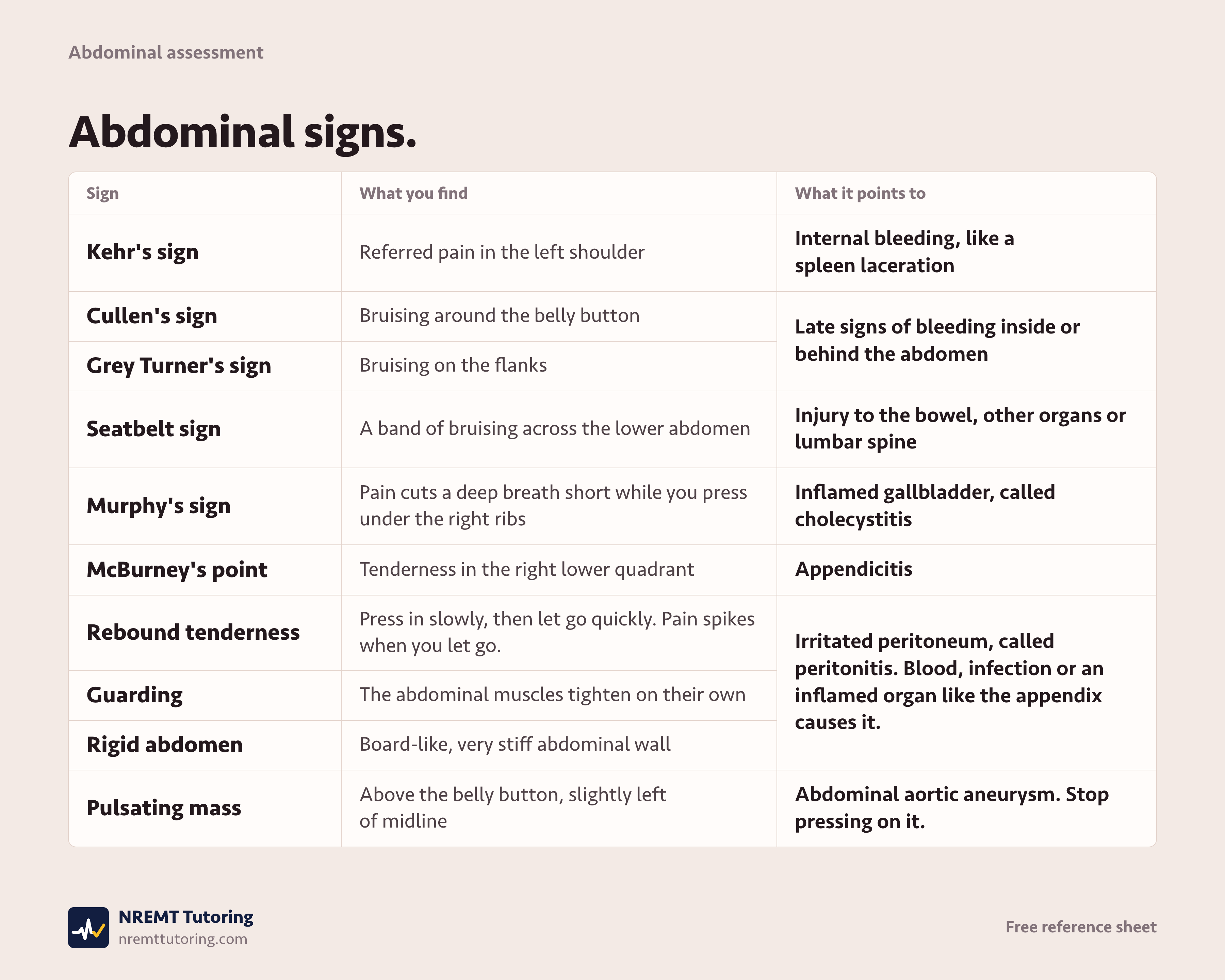
A free reference chart of the major abdominal signs: what you find for each one and what it points to, from Kehr's sign and Cullen's sign to Murphy's sign, McBurney's point, rebound tenderness, and a pulsating mass. Print it, save it, or work through it below.
Free to save, print, and share with your class. Updated November 1, 2026.
How to read the chart
The left column names the sign, the middle column is what you actually find on the patient, and the right column is what it points to. Signs that point to the same thing share one cell: Cullen's and Grey Turner's sit together, and so do rebound tenderness, guarding, and a rigid abdomen.
When a patient has several findings, look for the thing that stands out the most that you see the least often. That will help you narrow it down the fastest.
Kehr's sign: shoulder pain from the abdomen
Kehr's sign is referred pain in the left shoulder. It is usually a sign of internal bleeding, like a spleen laceration or a ruptured ectopic pregnancy.
Blood from an injured spleen pools under the left side of the diaphragm and irritates the peritoneum, the protective layer that lines it. The diaphragm's nerve, the phrenic nerve, comes from the same levels of the spinal cord as the nerves of the shoulder. The brain reads it as shoulder pain, and the patient feels it at the tip of the left shoulder, even though the shoulder is not hurt.
Bruising patterns
Cullen's sign is bruising around the belly button: blood has collected inside the abdomen or behind it. Grey Turner's sign is bruising on the flanks, the sides of the lower back: blood has collected behind the abdomen, where the kidneys sit.
Cullen's and Grey Turner's are late findings. A patient can be bleeding inside long before any bruising shows.
A seatbelt sign is a band of bruising across the lower abdomen from the lap belt. Suspect injury to the bowel or other organs under it, and to the lumbar spine.
Murphy's sign and McBurney's point
Murphy's sign is a sign of an inflamed gallbladder, called cholecystitis. Hold your fingers under the right ribs, in the right upper quadrant where the gallbladder sits, and have the patient breathe in deeply. The breath moves the inflamed gallbladder down against your fingers. If the pain stops the breath short, that is a positive Murphy's sign. Gallbladder pain is often worse after a fatty meal, and it can be referred to the right shoulder or shoulder blade.
McBurney's point is the spot in the right lower quadrant where appendicitis pain settles. At the start it is a dull, generalized ache around the belly button, from the inflamed appendix itself. Then it becomes sharp pain in one spot, as the inflamed appendix irritates the peritoneum over it, and that is when rebound tenderness and guarding can show up there.
Appendicitis pain is pretty constant. Pain that comes and goes points more to a kidney stone. In a woman of childbearing age, think of an ectopic pregnancy too.
An irritated peritoneum
The peritoneum is the protective layer around the abdominal organs. Blood, infection, or an inflamed organ like the appendix irritates it, and the same irritation under the diaphragm causes Kehr's sign.
For rebound tenderness, press in slowly and deeply, then let go quickly. The pain spikes when you let go, as the irritated lining moves back into place. Guarding is the abdominal muscles tightening on their own under your hand, and true guarding stays even when the patient is distracted. Any time the abdomen is rigid, especially board-like or very stiff, that is a sign of peritonitis, from bleeding or an infection.
Older adults may not show rigidity or guarding at all, even when the cause is serious.
A pulsating mass
A pulsating mass is an aneurysm bulging in the aorta. The weak wall of the vessel balloons out, and you can feel the pulse in it, just above the belly button and slightly left of the middle.
It comes with sudden, severe pain in the abdomen or back, and signs of shock if it is leaking. It is often an older patient with a history of high blood pressure. A pulsating mass is often there with an aneurysm, but not always.
Stop pressing on it. Keep the patient calm and still, and transport rapidly.
Practice: name the sign
A bike crash 20 minutes ago. The handlebar hit the left upper abdomen. There is guarding in the left upper quadrant, and the patient now reports left shoulder pain, though the shoulder was never hit. Pulse 118, skin pale and cool.
It is Kehr's sign. The shoulder was never hit, so the pain is referred from the abdomen. The spleen sits in the left upper quadrant, and blood from the injured spleen irritates the peritoneum under the diaphragm. The pulse of 118 with pale, cool skin is shock from the internal bleeding, so transport rapidly. The shoulder pain is the thing that stands out the most that you see the least often.
Common questions
- What is Kehr's sign?
- Kehr's sign is referred pain in the left shoulder. It is usually a sign of internal bleeding, like a spleen laceration or a ruptured ectopic pregnancy. Blood under the left side of the diaphragm irritates it, and the diaphragm's nerve comes from the same levels of the spinal cord as the nerves of the shoulder.
- What is the difference between Cullen's sign and Grey Turner's sign?
- Cullen's sign is bruising around the belly button, from blood collected inside the abdomen or behind it. Grey Turner's sign is bruising on the flanks, from blood collected behind the abdomen, where the kidneys sit. Both are late findings, so a patient can be bleeding inside long before either one shows.
- How do you check for Murphy's sign?
- Press under the right ribs, in the right upper quadrant where the gallbladder sits, and have the patient breathe in deeply. The breath moves the inflamed gallbladder down against your fingers. If the pain stops the breath short, that is a positive Murphy's sign, pointing to cholecystitis.
- What does a rigid abdomen mean?
- Any time the abdomen is rigid, especially board-like or very stiff, that is a sign of peritonitis, an irritated peritoneum, from bleeding or an infection. Older adults may not show rigidity or guarding at all, even when the cause is serious.
- What should an EMT do for a pulsating abdominal mass?
- Stop pressing on it. A pulsating mass just above the belly button, slightly left of the middle, points to an abdominal aortic aneurysm. Keep the patient calm and still, and transport rapidly.
- Can I print this abdominal signs chart or use it in class?
- Yes. The chart is free to view, download, print, and share with your class or study group. A link back to nremttutoring.com is appreciated but not required.
Now go answer questions on it
A chart tells you what separates them. Questions are what prove you can do it under time. Practice is free and unlimited, with a full explanation on every answer.
Start free practice