Normal Vital Signs by Age
A free reference chart of normal pulse, breathing rate, and blood pressure for every age from newborn to adult, with the systolic blood pressure that is too low at each age, plus the SpO₂, temperature, and capillary refill numbers that hold at every age.
Free to save, print, and share with your class. Updated October 21, 2026.
Younger means faster
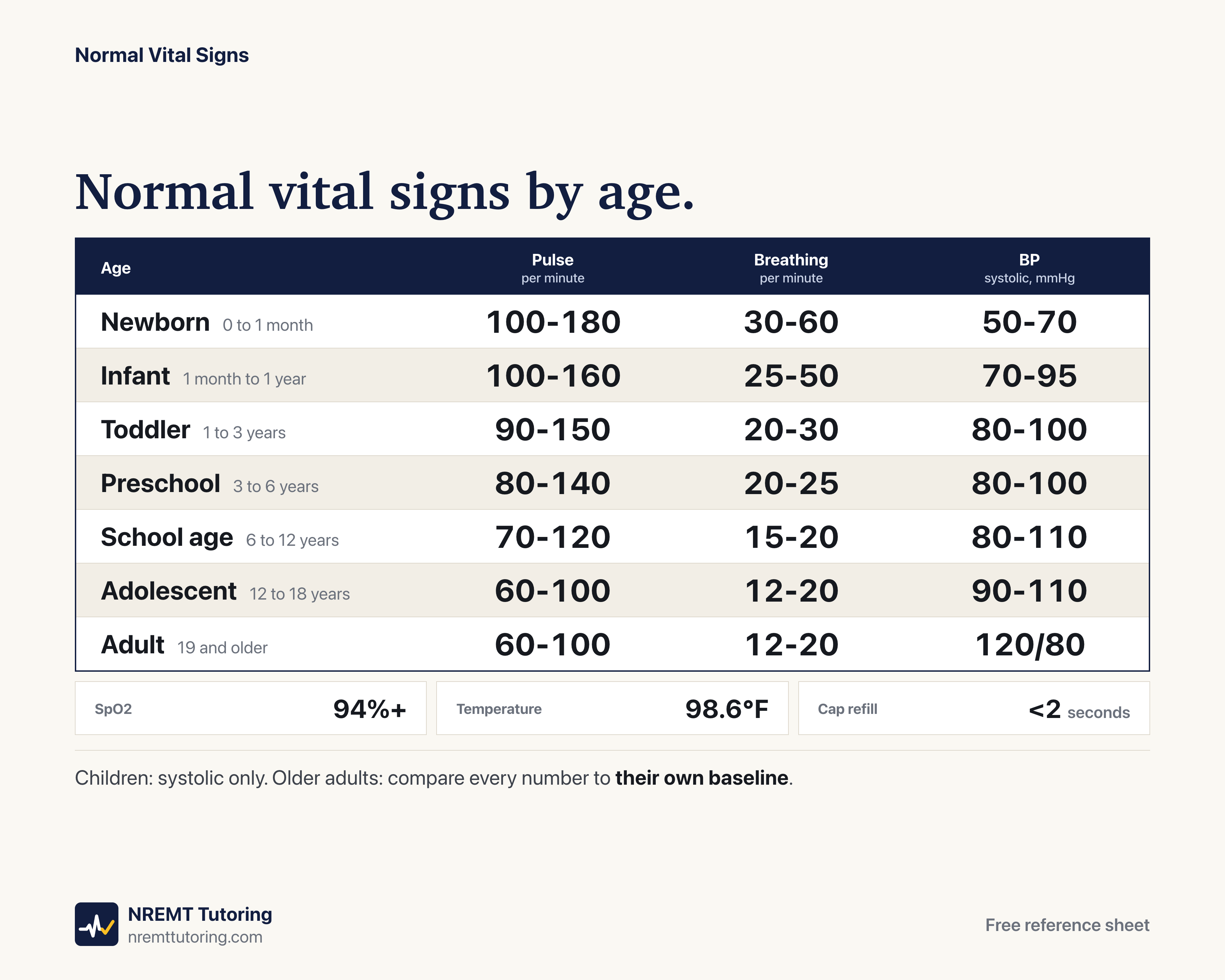
The pattern holds across the whole chart. Pulse and breathing are fastest in a newborn and slow down with every age group. Blood pressure runs the other way: lowest in a newborn and rising until adolescence.
A number is only normal or abnormal for an age. A pulse of 150 is normal for an infant and far too fast for an adult, and a breathing rate of 40 is normal for a newborn. Find the age first, then judge the number.
Newborns and infants
A newborn, birth to 1 month, runs a pulse of 100 to 180, breathes 30 to 60 times a minute, and has a systolic pressure of 50 to 70. A systolic under 60 is too low.
An infant, 1 month to 1 year, runs a pulse of 100 to 160, breathes 25 to 50 times a minute, and has a systolic pressure of 70 to 95. A systolic under 70 is too low.
Ages 1 to 10: 70 plus twice the age
For a child from 1 to 10 years old, a systolic pressure under 70 plus two times the age in years is too low. A 2 year old is too low under 74, a 4 year old under 78, and an 8 year old under 86.
Toddlers, 1 to 3 years, run a pulse of 90 to 150 and breathe 20 to 30 times a minute. Preschoolers, 3 to 6 years, run 80 to 140 and breathe 20 to 25 times a minute. School age children, 6 to 12 years, run 70 to 120 and breathe 15 to 20 times a minute.
Adolescents and adults
By adolescence, 12 to 18 years, the pulse and breathing match an adult: a pulse of 60 to 100 and a breathing rate of 12 to 20. An adolescent systolic under 90 is too low. In an adult, a systolic of 90 or lower is decompensated shock.
Older adults have no separate normal range. Their own baseline is their real normal, so get it from the patient, the family, facility staff, or the care record, and compare every number to it.
Normal breathing is not the same as adequate
An adult breathing rate of 12 to 20 is normal. A patient breathing over 28 with signs of distress, or under 8 on the number alone, needs assisted ventilations, and so does a patient breathing too shallow to move real air at any rate.
A rate of 22 is outside normal and worth watching, but it is not inadequate on its own. The exam tests the difference between abnormal and inadequate.
In a child, blood pressure changes last
A child in shock holds a normal blood pressure until the very end. The heart rate, breathing, skin color, capillary refill, and pulse strength all change first, because a child has a small blood volume and shunts it to the core. In a child 3 years old or younger, a blood pressure is not even worth taking.
A falling heart rate in a sick child is not good news. The heart rate climbs early, and when it drops while the child gets harder to wake, the child is wearing out. A slow heart rate in a child in distress means not enough oxygen and comes right before arrest.
SpO₂, temperature, and capillary refill
Three numbers hold at every age. SpO₂ should be 94% or higher, and a patient below 94% gets oxygen; a patient with COPD may run lower, so go by their baseline. Normal temperature is about 98.6°F.
Capillary refill should be under 2 seconds and is most useful in children. Cold skin makes capillary refill look slower, so judge it in a warm environment.
Common questions
- What is a normal heart rate for a child?
- It depends on the age. A newborn runs 100 to 180, an infant 100 to 160, a toddler 90 to 150, a preschooler 80 to 140, a school age child 70 to 120, and an adolescent 60 to 100, the same as an adult.
- What blood pressure is too low for a child?
- Under 60 systolic in a newborn and under 70 in an infant. From 1 to 10 years old, a systolic under 70 plus two times the age in years is too low. Over 10 years old, under 90 is too low.
- What breathing rate means an adult needs assisted ventilations?
- Over 28 with signs of distress, or under 8. A rate between 20 and 28 is abnormal and worth watching, but it is not inadequate on its own. A patient breathing too shallow to move real air needs ventilations at any rate.
- Why does a child in shock have a normal blood pressure?
- A child shunts blood to the core and holds the pressure up until the very end. The heart rate, breathing, skin, and capillary refill change first. A falling blood pressure in a child is a late sign that arrest is close.
- Can I print this vital signs chart or use it in class?
- Yes. The chart is free to view, download, print, and share with your class or study group. A link back to nremttutoring.com is appreciated but not required.
Now go answer questions on it
A chart tells you what separates them. Questions are what prove you can do it under time. Practice is free and unlimited, with a full explanation on every answer.
Start free practice