Glasgow Coma Scale
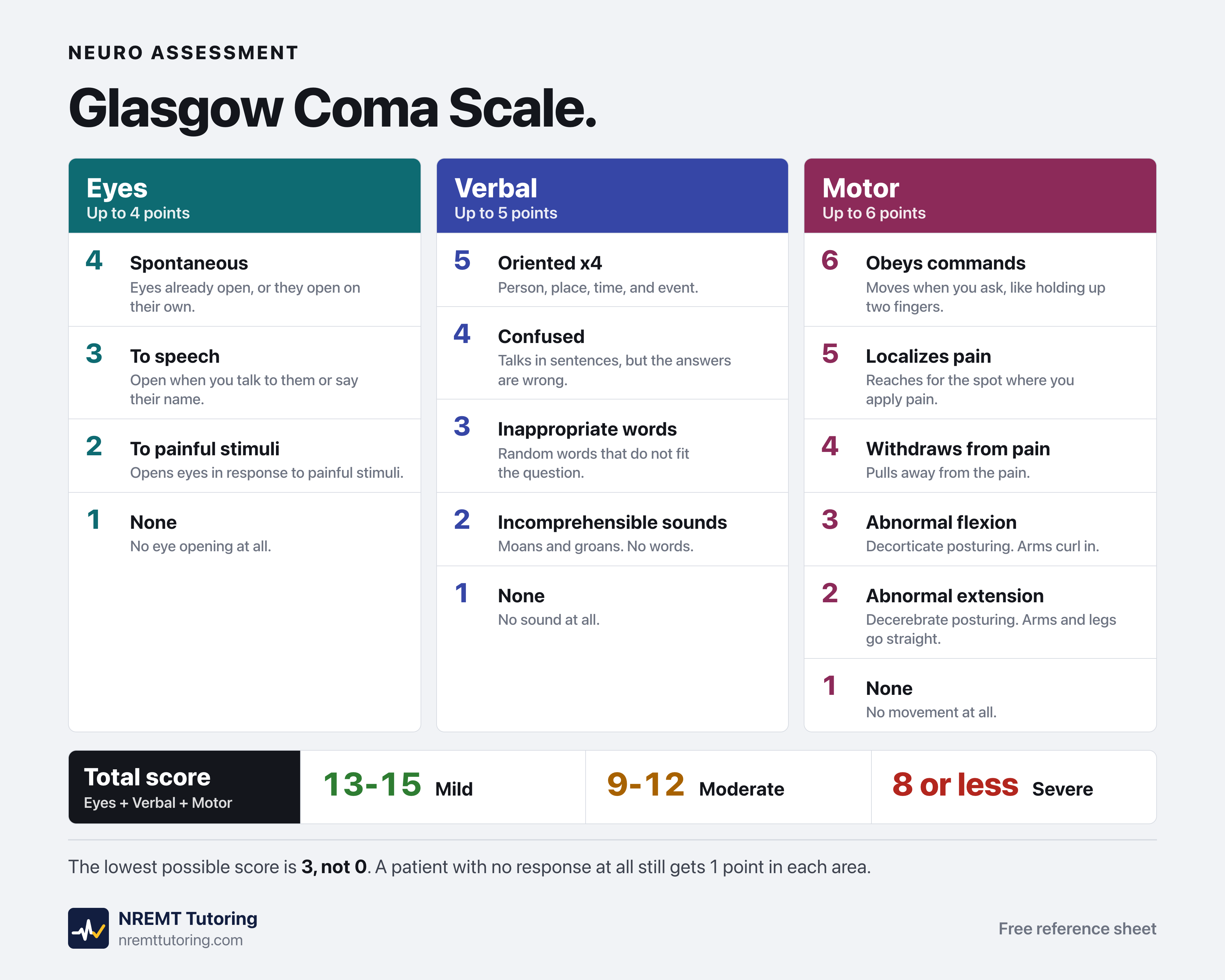
A free reference chart of the Glasgow Coma Scale: every eye, verbal, and motor response with its score, how to add up the total, and the mild, moderate, and severe ranges, plus decorticate and decerebrate posturing.
Free to save, print, and share with your class. Updated October 23, 2026.
Score each area, then add them up
The Glasgow Coma Scale has three areas: eyes, verbal, and motor. Score each area, then add the three together. Eyes go up to 4 points, verbal up to 5, and motor up to 6, so the highest total is 15.
The lowest possible score is 3, not 0. A patient with no response at all still gets 1 point in each area.
Eyes: up to 4 points
Spontaneous is a 4: the eyes are already open, or they open on their own. To speech is a 3: they open when you talk to the patient or say their name.
To painful stimuli is a 2: the patient opens their eyes in response to painful stimuli. None is a 1: no eye opening at all.
Verbal: up to 5 points
Oriented x4 is a 5: the patient knows person, place, time, and event. Confused is a 4: they talk in sentences, but the answers are wrong. Inappropriate words is a 3: random words that do not fit the question.
Incomprehensible sounds is a 2: moans and groans, with no words. None is a 1: no sound at all.
Motor: up to 6 points
Obeys commands is a 6: the patient moves when you ask, like holding up two fingers. Localizes pain is a 5: they reach for the spot where you apply pain. Withdraws from pain is a 4: they pull away from the pain.
Abnormal flexion is a 3, abnormal extension is a 2, and no movement at all is a 1.
The one people miss: pulling away is a 4, not a 5. A 5 means the patient reaches for the spot where you apply pain.
Decorticate or decerebrate posturing
Posturing is when the patient stiffens up, like a fighter who gets knocked out and goes stiff as a board.
Decorticate posturing is abnormal flexion, and it gets 3 points. The arms curl in toward the core: deCORticate, toward the core. Decerebrate posturing is abnormal extension, and it gets 2 points. The arms and legs push out, straight and stiff.
Both mean a serious brain injury. Decerebrate is worse, which is why it gets fewer points.
What the total tells you
A total of 13 to 15 is mild, 9 to 12 is moderate, and 8 or less is severe.
A patient at 8 or less cannot be counted on to protect their own airway. Be ready to manage it.
Practice: score this patient
After a car crash, her eyes open only when you say her name. She moans, but you cannot make out any words. When you apply pain, she pulls her arm away.
She is a 9. Her eyes are a 3 for opening to speech, verbal is a 2 for incomprehensible sounds, and motor is a 4 for withdrawing from pain. 3 + 2 + 4 = 9, which is moderate.
Common questions
- What are the highest and lowest Glasgow Coma Scale scores?
- The highest is 15: 4 for eyes, 5 for verbal, and 6 for motor. The lowest is 3, not 0, because a patient with no response at all still gets 1 point in each area.
- What GCS score is severe?
- 8 or less is severe, 9 to 12 is moderate, and 13 to 15 is mild. A patient at 8 or less cannot be counted on to protect their own airway, so be ready to manage it.
- What is the difference between decorticate and decerebrate posturing?
- Decorticate posturing is the arms curling in toward the core, and it gets 3 points on the motor score. Decerebrate posturing is the arms and legs pushing out, straight and stiff, and it gets 2. Both mean a serious brain injury, but decerebrate is worse.
- Is pulling away from pain a 4 or a 5?
- A 4. Pulling away from the pain is withdraws from pain. A 5, localizes pain, means the patient reaches for the spot where you apply pain.
- Can I print this Glasgow Coma Scale chart or use it in class?
- Yes. The chart is free to view, download, print, and share with your class or study group. A link back to nremttutoring.com is appreciated but not required.
Now go answer questions on it
A chart tells you what separates them. Questions are what prove you can do it under time. Practice is free and unlimited, with a full explanation on every answer.
Start free practice