Types of Pneumothorax
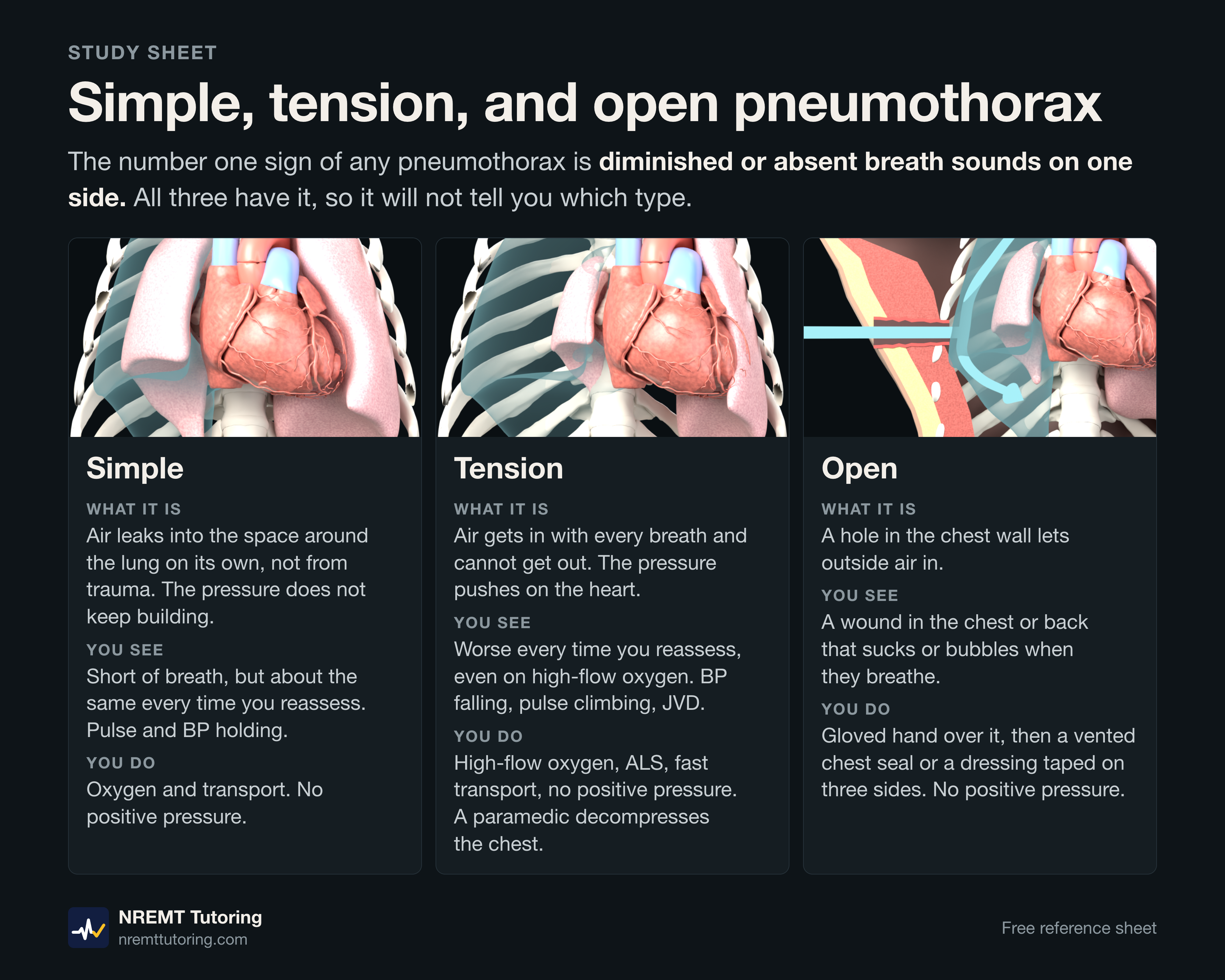
A free reference chart of the three types of pneumothorax: simple, tension, and open. What each one is, what you see on the patient, and what you do, plus the one sign all three share. Print it, save it, or work through it below.
Free to save, print, and share with your class. Updated November 19, 2026.
How to read the chart
Each column is one type of pneumothorax: simple, tension, and open. Read down a column for what it is, what you see on the patient, and what you do.
The number one sign of any pneumothorax is diminished or absent breath sounds on one side. All three have it, so it will not tell you which type.
What a pneumothorax is
A pneumothorax is when the lung is partially or fully collapsed. Normally the lung sits against the chest wall. Each breath, the chest wall moves out and the lung follows. When air gets into the space around the lung, the lung pulls away and collapses.
Stay away from positive pressure. CPAP or a BVM pushes more air into the chest. Use a BVM only if the patient's breathing is inadequate.
Simple pneumothorax
In a simple pneumothorax, air leaks into the space around the lung and the lung partly collapses. The pressure does not keep building, and the heart stays in place.
It happens on its own, not from trauma. Tall, thin, younger men and smokers are more prone, and so is anyone with lung disease.
The patient is short of breath, but about the same every time you reassess. Pulse and BP are holding, and the neck veins are flat sitting up. Give oxygen, transport, and keep reassessing. Stay away from positive pressure ventilation.
Tension pneumothorax
In a tension pneumothorax, air gets in with every breath and cannot get out, like a one-way valve. Air fills that side, the lung fully collapses, and the heart and big veins get pushed over. A broken rib that punctures the lung is a common cause.
The pressure collapses the lung, then pushes on the heart and big veins. Less blood gets back to the heart, and BP falls. This is obstructive shock.
How you spot a tension
The patient gets worse every time you reassess, even on high-flow oxygen, because the pressure keeps building. BP falls and the pulse climbs: less blood gets back to the heart, so the heart speeds up. JVD shows even sitting up, as blood backs up in the neck veins. A BVM gets harder to squeeze, because you are pushing air into a chest already under pressure.
A trachea shifted away from the injured side is a late sign and is often missing. Do not wait for it. Pain and diminished breath sounds show up in a simple too.
Care is high-flow oxygen, ALS, and fast transport. Stay away from positive pressure ventilation. A paramedic decompresses the chest.
Open pneumothorax
In an open pneumothorax, a hole in the chest wall lets outside air in, usually from a stab wound or gunshot wound. You see a wound in the chest or back that sucks or bubbles when they breathe. Check the back for an exit wound.
Cover it with a gloved hand right away. Then use a vented chest seal, or plastic taped down on three sides. The open side works like a flutter valve. When the patient breathes in, the plastic is sucked flat, so outside air cannot get in. When they breathe out, the open side lifts and the trapped air escapes.
Three sides is only for the open pneumothorax. Anywhere else, especially the neck, seal all four sides.
How an open pneumothorax turns into a tension
If the dressing is taped on all four sides, or gets clogged, the hurt lung keeps leaking air with nowhere to go. Lift one edge.
A BVM or CPAP pushes more air out through the hole in the lung. Stay away from positive pressure.
Watch for JVD, falling BP, and breathing that keeps getting worse. A paramedic decompresses the chest.
Practice: what is most likely going on?
A 22-year-old man, tall and thin, with sharp right chest pain that came on suddenly in class. Short of breath, and no injury. Breath sounds are diminished on the right and clear on the left. BP 126/80, pulse 104. Is it an asthma attack, a panic attack, a heart attack, or a pneumothorax?
It is a pneumothorax. Breath sounds diminished on the right are the number one sign: the lung on that side is collapsed. Sudden, sharp pain on one side with no injury means air leaked in on its own. A tall, thin, young man is the patient most prone to a pneumothorax that happens on its own. Asthma wheezes on both sides, and a panic attack or heart attack does not take away breath sounds on one side.
Common questions
- What are the three types of pneumothorax?
- Simple, tension, and open. In a simple pneumothorax, air leaks into the space around the lung on its own, not from trauma, and the pressure does not keep building. In a tension pneumothorax, air gets in with every breath and cannot get out, and the pressure pushes on the heart. In an open pneumothorax, a hole in the chest wall lets outside air in.
- What is the number one sign of a pneumothorax?
- Diminished or absent breath sounds on one side. All three types have it, so it will not tell you which type.
- How do you tell a tension pneumothorax from a simple one?
- A simple pneumothorax stays about the same every time you reassess, with pulse and BP holding. A tension gets worse every time you reassess, even on high-flow oxygen, with BP falling, pulse climbing, and JVD. A trachea shifted away from the injured side is a late sign and is often missing, so do not wait for it.
- Why is a chest seal taped on three sides?
- For an open pneumothorax, the open side works like a flutter valve. When the patient breathes in, the plastic is sucked flat, so outside air cannot get in. When they breathe out, the open side lifts and the trapped air escapes. Three sides is only for the open pneumothorax. Anywhere else, especially the neck, seal all four sides.
- Should you use a BVM or CPAP on a pneumothorax?
- Stay away from positive pressure. CPAP or a BVM pushes more air into the chest. Use a BVM only if the patient's breathing is inadequate.
- Can I print this pneumothorax chart or use it in class?
- Yes. The chart is free to view, download, print, and share with your class or study group. A link back to nremttutoring.com is appreciated but not required.
Now go answer questions on it
A chart tells you what separates them. Questions are what prove you can do it under time. Practice is free and unlimited, with a full explanation on every answer.
Start free practice